


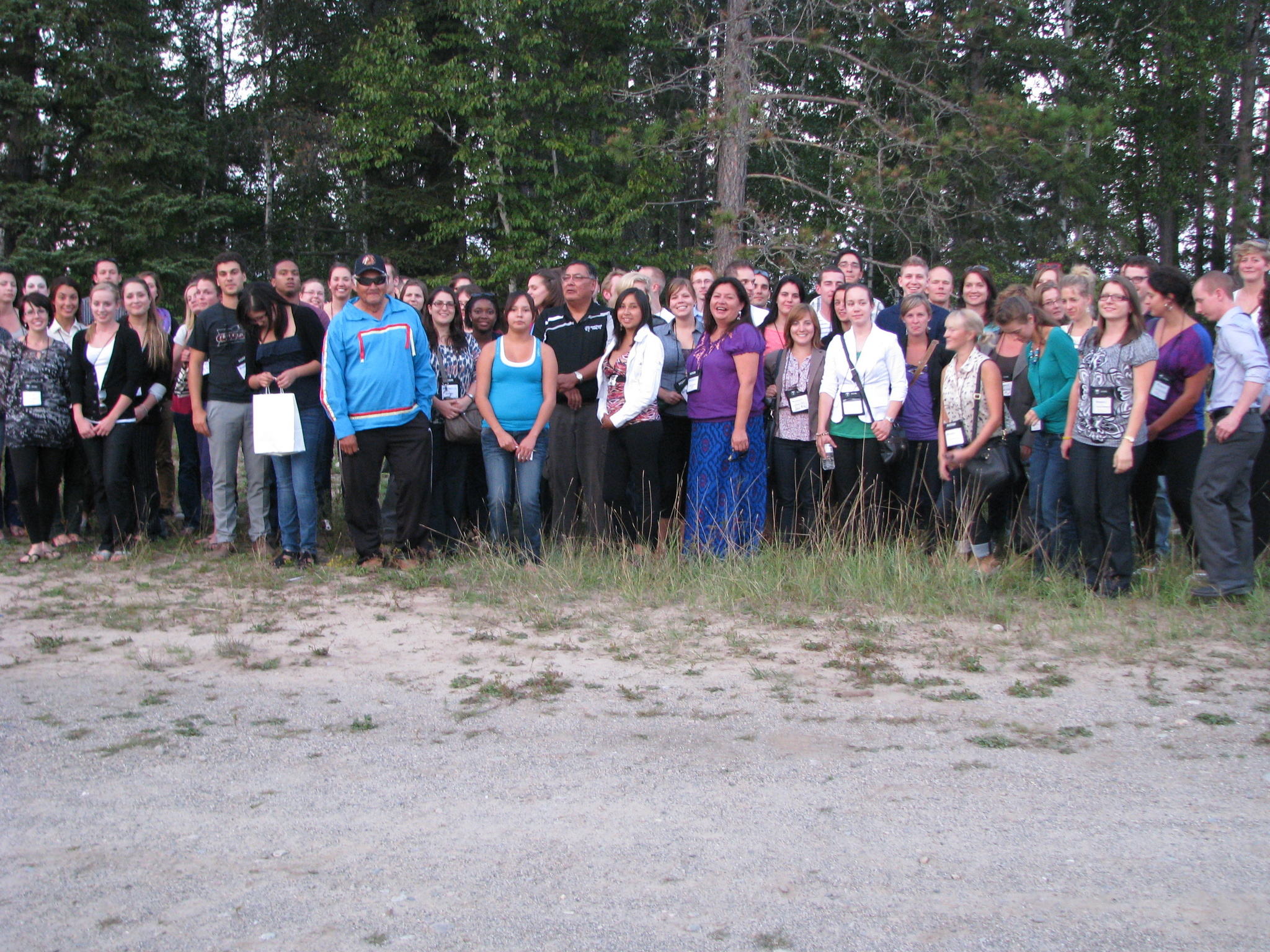
Over 90 medical students, who are working towards becoming doctors, visited the small community of Whitefish Bay, Lac Seul First Nation on Aug. 21.
They came at the invitation of Chief Clifford Bull who resides in the community. The main purpose was to have the students see for themselves the size of some of the communities of the north.
Along with the doctors came presenters.
First on the agenda was Bull, who welcomed the students and visitors to Lac Seul First Nation. He informed the crowd that this was his home.
Also he announced to all it was his mother’s 79 birthday.
He introduced the next person, the councillor of the community of Whitefish Bay, Roger Bull. Councillor Bull too, welcomed the visitors to his community where he also grew up.
He told them a delicious meal of fresh pickerel was on the menu, but first the visitors had to listen to some presentations that the Lac Seul First Nation had arranged.
An agenda had been passed out. Members of the new youth chief and council came forward also to welcome the students, staff and others. Tina Armstrong, director of Aboriginal Affairs at the Northern Ontario School of Medicine (NOSM) came in front and introduced the dean of Faculty, Dr. David Marsh.
He, in turn, spoke about NSOM, his role with the program and where he hailed from.
He told the people he was Mic’mwa from Newfoundland and was one of the very few of the native student doctors to come out of medical school.
A powerful and moving power point presentation on the history of Lac Seul was shown by Renee Southwind and Tom Chisel.
Presenters came one after another. Janet Gordon came forward and spoke about her work in the field of services to the First Nations people. She is employed with the Sioux Lookout First Nations Health Authority. Next came Helen Cromarty.
Helen introduced herself as a former nurse. Her role is in the new Meno Ya Win Health Center, as the Special Advisor to the board of directors.
Both Cromarty and Gordon encouraged the students to come north to work. Cromarty’s prominent word of advice to the students was, “LISTEN.” She also said that the one huge difference the new hospital has with other hospitals, is the food. It is the only hospital that is allowed to serve traditional foods such as moose, deer and wild rice.
Garnet Angeconeb came next to speak about the residential school era and how it continued to affect people today. Angeconeb said when he first came into the building he felt a silence. But when the students came in, he felt hope, hope for change. “If we can understand our collective past, then we can look forward to our future,” he said.
As time was quickly drawing to a near closing and people were getting hungry, Gail Winter made a short presentation about “transportation” for First Nations people for medical treatments.
A blessing of the food was made by one of the women of the Whitefish Bay community. A feast of fresh pickerel, potatoes, vegetables, meat trays, vegetable trays and fruit trays were made available for all present.
During the meal, one student, Allison Webb spoke about her experience in Nibinamik. “I had a great time in my placement there. I made lots of friends. I was sad to leave,” Webb said. She is from Parry Sound and attends medical school at Laurentian University.
The students had a fun time visiting Whitefish Bay, Lac Seul. They were made to feel welcome and the residents of the community hope to see some of these students come back and work as doctors here in the north.


Maachestan, the Cree word for the annual spring river ice breakup, is happening all along the James Bay coast. This is a very important time of year for...
I was proud to see First Nation youth representing our northern homelands on the international stage this past month at the United Nations. Jeronimo...