



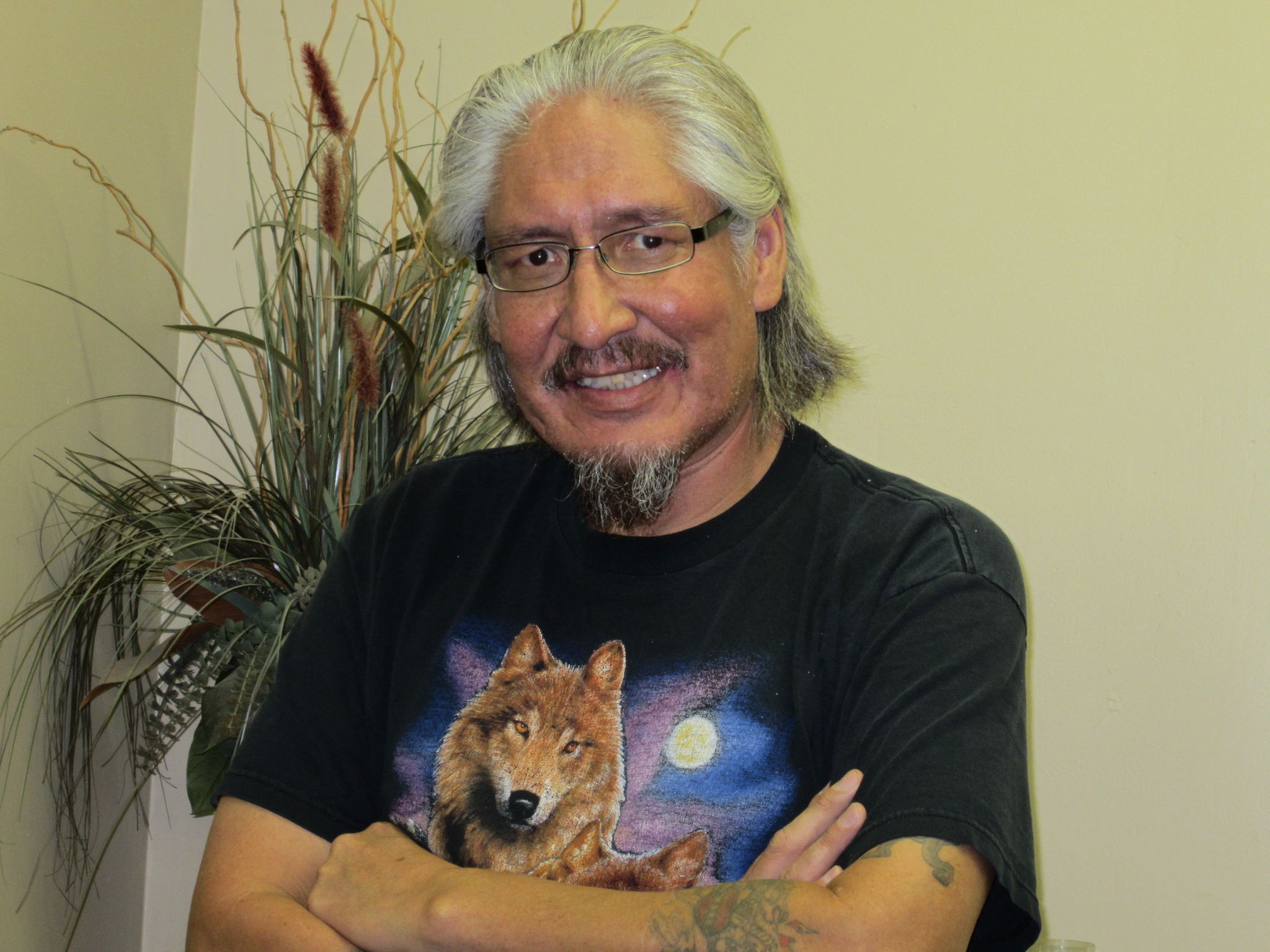
In 1962, Victor Joseph Seegerts died a hero’s death when the commercial fishing boat he worked on drifted from the island where he and his fellow crew members were stopping.
Seegerts, a Dene from Uranium City, Alberta, braved the frigid waters of Lake Athabasca and swam to the boat, but was unable to scale the high sides of the boat to climb aboard. After numerous attempts, he succumbed to cold and exhaustion.
“He died trying to save the lives of other people,” says his son, David Seegerts. Even though David was only two years old at the time, the youngest in a family of seven children, “that story inspired me to follow his example to save the lives of my people.”
The road to fulfilling that dream would have many twists and turns. David’s mother remarried. Her new husband was violent and abusive to her and the children. By the time David was eight, he began running away from home, but it wasn’t until he attempted suicide at the age of 14 that he was placed in a foster home. That proved to be a turning point for him.
“It was a good foster home,” he recounts. “I got into cadets and martial arts. I wanted to learn to protect myself.”
He became a favourite with his foster parents because of his respectful attitude and good manners. It was there that he learned consequences and a work ethic that he has maintained all his life.
“To this day I love work. I started working at the age of 12. There was an old man known as Garbage Joe because he drove a garbage truck. He would hire us kids to help him. We’d line up outside his door at 5 in the morning, and he’d take the first four in line. I was always one of the ones picked.
“Also, my foster dad took me cutting wood and chopping and piling on weekends for money. Then we built a garage. I started to understand the concept of work and money.”
David also enjoyed travelling across Canada on holidays with his foster family, and he was close to one of his foster brothers. Despite the positive grounding he was getting, when he was sixteen, he hitchhiked to Thompson, Man. to visit one of his brothers who was involved with a motorcycle gang. After a few months there, David moved on to Edmonton where he spent his time living on the streets, couch surfing, selling drugs and partying.
“I hung out with shady people for a couple of years. Then I got busted. That’s when my life changed. Getting busted was the best thing that happened to me.”
David decided to hitchhike to Fort McMurray to get away from the life he was leading. On the highway he inhaled a peanut and passed out. A passing motorist stopped and saved him by administering the Heimlich maneuvre, then gave him a ride and offered him a job in his Fort McMurray warehouse.
“He told me he hired me because I was wearing a nice sweater. I’ve always had deep respect and manners, and I always looked good. My mother instilled that in me.”
That near-death experience convinced David that he was being spared for a purpose. However, he continued to drift between jobs, cities and relationships. During the 1980s he was living in Calgary, “still a party animal with no direction. I always maintained a job, though.”
One day he saw an advertisement for a one-year course in survey technology. It was a limited-enrolment course that required more schooling than he had. But David was not one to give up.
“I had a Grade 7 education and needed Grade 10. But I had perseverance and I had desire, so I phoned up the course instructor, and was accepted. Throughout that course I locked myself in my bedroom and studied, learning trigonometry and calculus. I passed my math and got 80 per cent in my fieldwork.
On graduating, Dave landed a job with an engineering firm in Edmonton.
“I was nicknamed “Psycho Dave” because of my work ethic. I used to cut two-and-a-half kilometres of survey line a day. I worked seven days a week. I loved it.”
Dave eventually moved to Vancouver to be closer to family, and stopped drinking. But problems followed him, in the form of spending two years in the legal system fighting false charges.
The experience traumatized him and brought him close to suicide again, until an acquaintance working with the Hey’-Way’-Noqu’ Healing Circle persuaded him to get counselling.
While he was living in Vancouver, working for a surveying company, he was approached by an agent in a coffee shop. She encouraged him to consider an acting career, and gave him her card. Five months later, he called, and “the next day I was on The X-Files. I became in demand right away. I worked with Sentinel, Walt Disney, did eight months with Hawkeye: Last of the Mohicans as a stand-in.”
Over the next nine years David enjoyed steady work in every aspect of television and film, including acting, set building, script writing, directing, videography and sound. “I had the bug. I saw an ad for a training program for film and video technicians and applied. I was one of the 16 accepted out of 4,000 applicants.”
Upon graduating from the program, he went to work for the National Film Board as a set carpenter. That led to work with Nickelodeon as a carpenter with Sabrina, the Teenage Witch, Brothers of the Frontier and Wounded. “Every show I worked on I got an acting part as well.”
However, after several accidents that shattered both kneecaps and an ankle, his career changed direction. He began volunteering for native organizations and a women’s shelter in Vancouver. He was invited by Aboriginal Community Careers Services Society (ACCESS) to work with Blade Runners, a program designed to mentor and help homeless and at-risk youth in gaining employment.
David threw himself into his new career with his typical drive and passion, acquiring a diploma in employment counselling.
“Later I got to develop my own programs in Prince George, B.C., a very racist town. I became coordinator, program developer, facilitator and job developer for the program, putting 12 kids at a time through a 4-week course, mentoring and liaising. I loved it because I love hard work and being in the limelight and being productive. The program had an 85 per cent success rate when I left Prince George.”
Understanding first-hand the issues that many of the youth struggled with, David developed anger management workshops and non-violent workshops. Later, he went to Saskatoon to develop life skill programs and social programming for the Saskatoon Tribal Council.
In 2011 a Facebook friend in Kakabeka suggested he move to Thunder Bay, saying, “We need people like you here.” He decided to accept the challenge, and relocated. He began working for Ka-Na-Chi-Hih, facilitating workshops in anger management and addiction awareness, and in June of 2012 was hired as a residential worker with Creighton Youth Services. In addition he plans to do workshops in Niagara Falls and Sioux Lookout. Another of his projects is using his skills in film work to create a production with the Creighton Centre.
“I want to get these kids telling their stories. That’s all they want. Kids want someone to listen to them.”
At 52, David’s dream of following his father’s example of helping his people is being fulfilled. “I love working with these kids. They like my approach. I talk at their level.” It was in Thunder Bay that David also met his life partner, Alice Sabourin, an instructor in Aboriginal Studies at Lakehead University.
“I think it was a godsend that a co-worker introduced me to her. We both have the same goals. We both work out at a gym every day and are committed to our health.” They also share a passion for counselling youth at risk.
“We both love them from the bottom of our hearts.” Together they are working on developing their own company to share their expertise with other groups.
David still does occasional surveying work, and is learning photography. He is also working on writing a book about his life and experiences. He finds that his background in the arts and entertainment world offers hopes and inspiration to his young clients.
“I can relate to them because I was one of them and I overcame.”



Maachestan, the Cree word for the annual spring river ice breakup, is happening all along the James Bay coast. This is a very important time of year for...
I was proud to see First Nation youth representing our northern homelands on the international stage this past month at the United Nations. Jeronimo...