



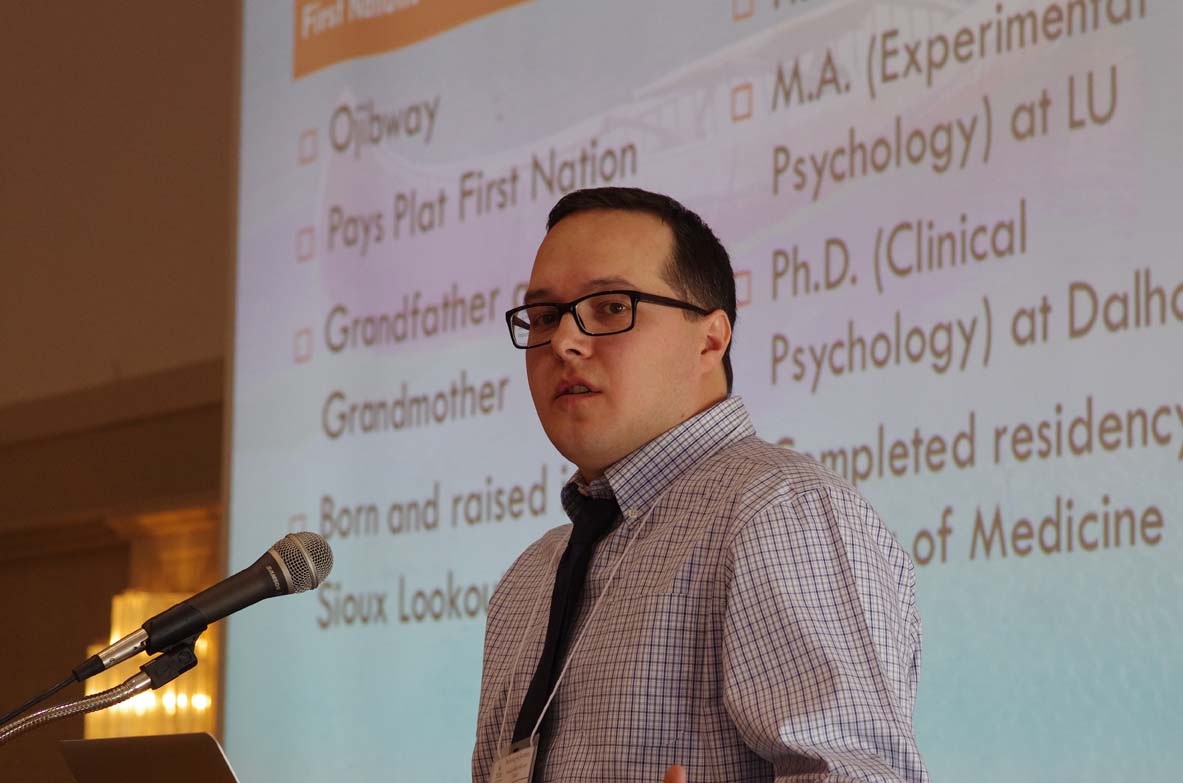
Pays Plat’s Chris Mushquash showed how a teepee, like people, will eventually fall down as its supports are removed during Dilico Anishinabek Family Care’s Revisiting Our Journey: Healing Starts with our Youth conference.
“Imagine yourself in the tent — each pole represents a particular aspect of your wellbeing, for example we can imagine poles representing Elder’s teachings, our language, our family, clean water, education and so on,” said the assistant professor in the Department of Psychology at Lakehead University and the Northern Ontario School of Medicine during his conference-opening keynote presentation. “Inside the tent we also have a fire and the goal is to keep the tent standing above the fire. Fire brings warmth and safety, but it also to be respected because it can also do harm.”
Mushquash asked the audience to imagine removing the poles one by one, noting that he developed the teepee story while working with a young First Nations person who had been engaging in self harm and other serious behaviors.
“First we remove our Elder’s teachings, next we remove our language, then we remove family support, and as we continue removing different aspects of support the tent becomes very unstable,” Mushquash said. “It’s no longer in balance; finally it falls into the fire. So if we don’t make sure these aspects of our health are balanced, we might become unstable and we can fall.”
Mushquash said when people feel themselves falling, they reach out for the closest thing to brace themselves.
“The closest things are our coping strategies,” Mushquash said. “We can also use these strategies as poles when other poles are being removed. They can help us maintain balance, even when our coping strategies are harmful — some people cope by using alcohol.”
Mushquash said alcohol might not be the best pole to use, but it is a pole and in that moment it is keeping somebody out of the fire.
“If we remove alcohol, we need to put another coping strategy in there,” Mushquash said. “Whenever we remove one, even if it is an unhealthy coping skill, we must ensure we replace it with something else. Otherwise we are still at risk of upsetting the balance and falling and reaching out for the most familiar thing to grab for support.”
Dilico’s Mental Health and Addictions Services hosted the conference from March 4-5 for Dilico staff and community partners at the Airlane Hotel and Conference Centre in Thunder Bay.
“The focus of this year’s conference is our youth,” said Micheal Hardy, Dilico’s executive director. “The work of First Nations people and practitioners demonstrates that cultural knowledge plays a valuable role in the development of culturally competent and safe interventions for working with youth who are experiencing difficulties.”
The conference included a keynote address by Peepeekisis First Nation’s Monique Gray Smith on Belief in the Strength and Resiliency of Our People, a Healing Through Hip Hop presentation by Shibastik and a number of workshops, including Ron Kanutski’s Healing Wounds Through Cultural Identity workshop.
“I’m talking about the importance of identity in healing wounds,” said Kanutski, owner of With Care Consulting and a Lake Helen band member. “There’s four things that we need as children, and when we don’t get them we continue to need them as youth, and when we don’t get that, we need them as adults.”
Kanutski said the four areas are: a sense of belonging, a sense of self-esteem, a sense of identity or role and a sense of purpose.
“All programs and services need to be geared towards that to make a difference,” Kanutski said. “That is where the emphasis should be placed, rather than looking at intervention and prevention. We need to focus on those four basic things for First Nations people right now, for ourselves, for our families, for our community members and for our nation as a whole.”
Kanutski said when someone is missing a sense of belonging, they will be looking for where they came from for the rest of their life.
“So it is important to be connected through our language, through our community, through our clans, through our name,” Kanutski said. “There’s a lot of different ways to tie into that belonging. The most important thing is a sense of belonging and when children don’t have that, they suffer.”
The conference was emceed by Stan Wesley of Moose Cree and subsidized by Health Canada through the National Alcohol and Drug Strategy.


First Nation youth representatives are letting the world know that Indigenous people are ready to stand up and protect the land. Keira Spence, Kohen...
My home community of Attawapiskat First Nation is celebrating the annual graduations of students from Kattawapiskak Elementary School and Vezina Secondary...