


Susan Scott, a freelance writer from Calgary, tells the story behind the title of her book All Our Sisters: Stories of Homeless Women in Canada.
While starting research on the book in Winnipeg, one of the first people Scott met was a young woman, abused as a child, who had worked as a prostitute to afford a drug habit.
“I got it,” the woman told Scott excitedly, after being asked to help come up with the book title. “Every Female Relative You Could Possibly Imagine.” They agreed to a shorter version, All My Sisters.
The woman took pride in her contribution. “The next day was the only day I saw her happy,” Scott recalled during her opening address at the Turtle Island Writing Festival in Red Lake, hosted Sept. 27-29 by the Fool’s Gold Writers group.
All My Sisters tells the stories of 39 homeless women, from Vancouver to Ottawa.
“For some women, all they had left was their story,” said Scott, who offered them opportunities “to be able to tell me anything and not be judged.”
Some of the women appeared at the Red Lake Heritage Centre, in photos on the projection screen, as Scott talked.
“She was the second woman in Canada convicted of being a pimp,” Scott said of one photo subject, a tattoo on her upper arm and graffiti on the wall behind her. “She’s not proud of that.” As Scott got to know her, she found “underneath that tough exterior, she was just a child wanting to be loved. No one had asked her story before.”
It has become a success story. “Last I heard, she was running a sawmill,” Scott said.
“I began to feel a responsibility to speak for and about them when they couldn’t,” she said of the women she profiled.
“Also, they knew they were helping me. They said ‘Stories can change the world’ … and ‘We can make a difference for other women by telling our stories so that people understand.’ It’s very painful to tell those stories when you’ve been so badly abused by the system, by other people, so they were incredibly brave.”
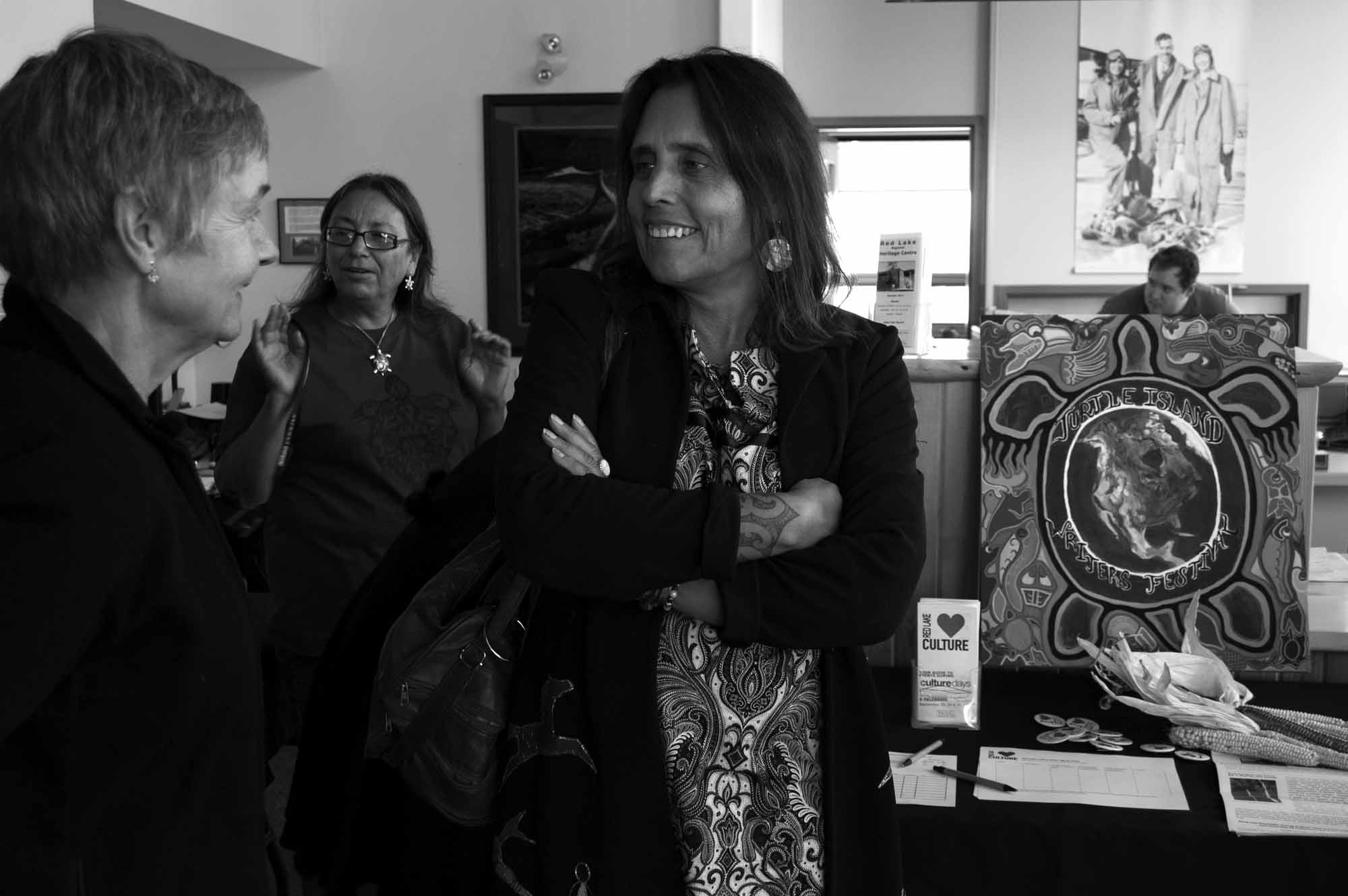
The next evening, about 50 people gathered at the Heritage Centre to hear a panel discussion based on the theme “healing with words.” Joining Scott on the panel were Kathy Tetlock, a local author, poet and blogger; arts educator Lila Cano; and Winona LaDuke from the White Earth Reservation in northern Minnesota, an internationally acclaimed author and activist devoted to protecting the lands and life ways of Native communities.
Tetlock wrote and self-published a book, The Cedar Canoe: What happened to Ryan?, after her son Ryan was found dead from an apparent overdose.
“I’ve been writing since I was 12, since my sister gave me my first diary,” Tetlock said. “It’s always been my way of healing. Whether someone else reads it or not, it helps get that confusion out of your head.
“After losing my son, when my hands stopped shaking and I could write, I started writing,” she said of her book. “I had to tell the story for others but also for myself.”
Cano spoke of how a film project transformed a group of Dryden High School students, most of them from First Nations. Supported by mentoring from Thunderstone Pictures filmmakers and Cano, they wrote an original screenplay based on the legend Eagle versus Sparrow, which teaches humility. The students also participated in all aspects of producing it as a film, from operating cameras and lighting to acting and costume-making. The film has been a hit, earning honourable mention for Best Canadian Short at the imagineNative Film + Media Arts Festival in Toronto and screening at other events in Canada and the U.S.
“When we started working with the kids they all came in with hoodies on, they wouldn’t talk to each other, wouldn’t even look at each other,” Cano recalled. “At the gala screening … (they) were standing up in front of 350 people and saying ‘We did this, you can do this.’ The beautiful thing about it was … the pride in their faces and the relationships of healing with each other, with their community, with the non-Aboriginal culture. It was pretty powerful.”
LaDuke talked about healing from colonialism in her community.
“For us, the recovery of our drums and the recovery of our Midewiwin Society and recovery of our ceremonies … it coincided with a lot of things like the recovery of our food, and it makes us better people.” Harvesting traditional foods of wild rice and berries, deer, and northern varieties of corn and squash contributes to better health and a sustainable local economy, she said.
“That’s what I’m working on in my community. I write about it … and tell a lot of stories about people who are doing this.”
Before the writers festival started, Scott visited the Red Lake District High S chool for presentations about All My Sisters, homeless women, and the need for personal and political action to address the issue. Toward the end of one presentation, a student shared her experience of being homeless in Red Lake, and of being a single mother surviving on $432 a month in social assistance.
“I was profoundly moved,” said Scott. “She’s aiming for a career … she seems very focused. She also thinks, as I do, that it’s important to break down the barriers and to talk openly about her situation.”
At the Heritage Centre, Scott showed a photo of another woman. “Sometimes there is a happy ending,” she said. For a long time the woman in the photo had lived under a bush in a park, but she found the help, housing and medication she needed. She does volunteer work now, says Scott, and has a purpose in life.
“Everyone has a story,” she told Scott.



Maachestan, the Cree word for the annual spring river ice breakup, is happening all along the James Bay coast. This is a very important time of year for...
I was proud to see First Nation youth representing our northern homelands on the international stage this past month at the United Nations. Jeronimo...