


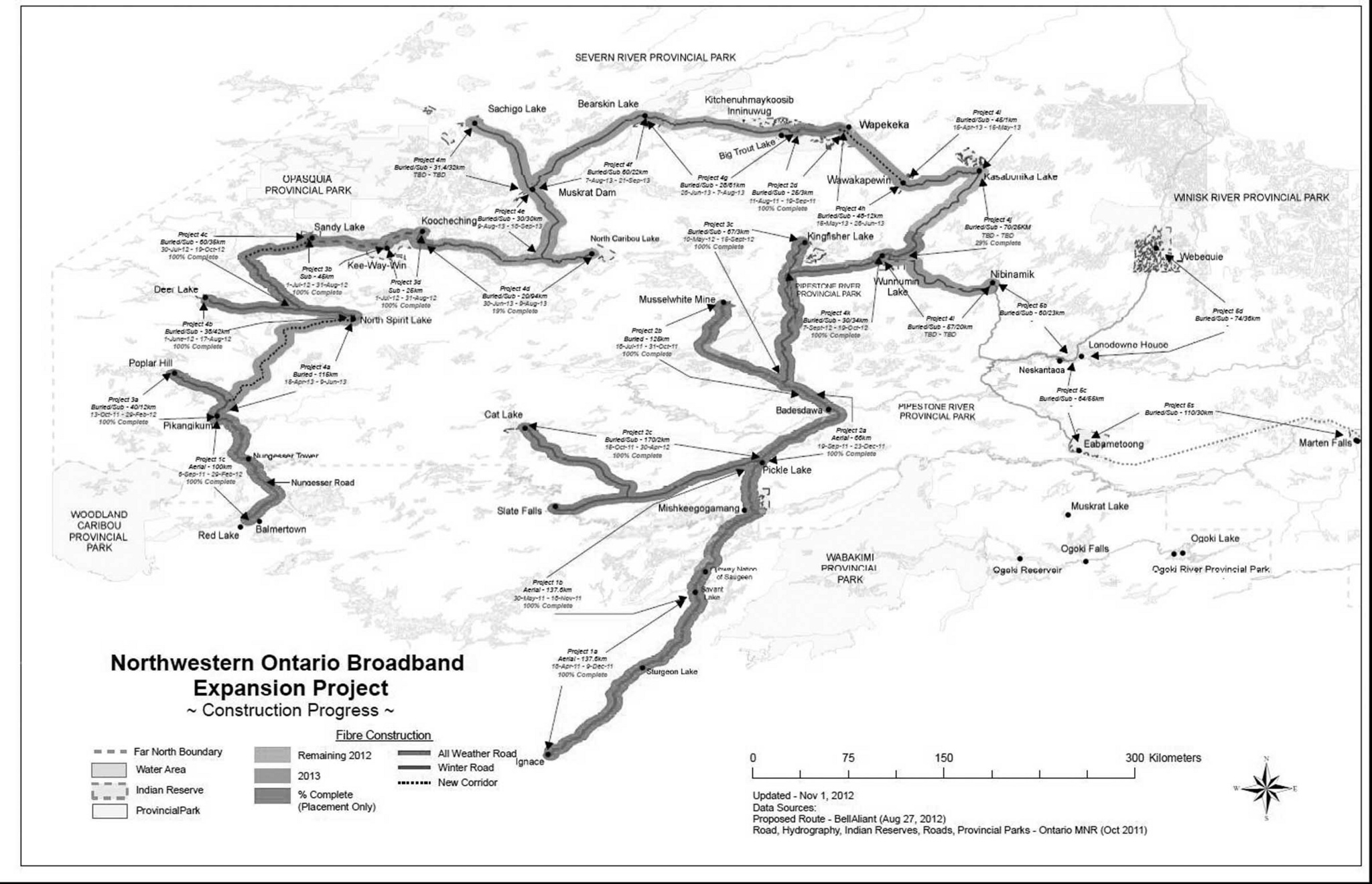
The Nishnawbe Aski Nation broadband fibre optic cable network has been rerouted around Big Trout Lake after Kitchenuhmaykoosib Inninuwug (KI) raised concerns about an underwater route across the lake.
“We told them, no, it’s not going underneath the water,” said KI Chief Donny Morris. “I told them no, this is the alternate route I am proposing on the KI Harvesters Route.”
The underwater route was part of the broadband line extending between KI and Bearskin Lake. The rerouted route goes around the north side of Big Trout Lake.
“We’re going off the reserve,” Morris said. “I’m exercising my authority that this is my territory. We’ve already picked the line cut where we want to go — it’s off reserve.”
Morris said the rerouted line has been approved by the Ontario government and work to clearcut the route began on March 19.
“With the line, I’m optimistic we can probably get some work out of there through the summer time,” Morris said. “I hear they’re in Wunnumin, so they’ve got to go from Wunnumin to Kasabonika, Kasabonika to Long Dog, Long Dog to Wapekeka, then that (Wapekeka to KI) line is already here.”
KI posted a Youtube video online in mid-March explaining the community’s decision to not allow an underwater route due to the KI Watershed Declaration, which protects all the waters that flow into and out of Big Trout Lake as well as the surrounding lands.
“Now, as of today, I don’t know how many semi’s are rolling in with those rolls (of broadband cable),” Morris said on March 19.
Morris looks forward to better medical services once the broadband cable is connected.
“I’m excited about it in the medical field,” Morris said. “I assume we will be able to utilize it through medical areas rather than sending people out. That’s why I’m so keen on it — I know it will save my community some monies. We spend a lot on paying people to go out with their family or friends: hotel, flights, meals.”
Morris also believes the broadband cable will improve education services for community members, noting that some community members who dropped out of school in the past are now looking at resuming their educational journey.
The 2,300 kilometre broadband cable will eventually provide high speed Internet services to 26 First Nation communities that currently rely on outdated satellite and microwave technology. Although Fort Severn and Weenusk are not being connected, those two communities will still receive higher speed Internet service because the satellite service they receive will no longer be spread across many communities.
Benefits expected from the broadband cable include: the creation of network service jobs, the opening of new economic opportunities and an enhancement of life for the First Nation communities.



First Nation youth representatives are letting the world know that Indigenous people are ready to stand up and protect the land. Keira Spence, Kohen...
My home community of Attawapiskat First Nation is celebrating the annual graduations of students from Kattawapiskak Elementary School and Vezina Secondary...