



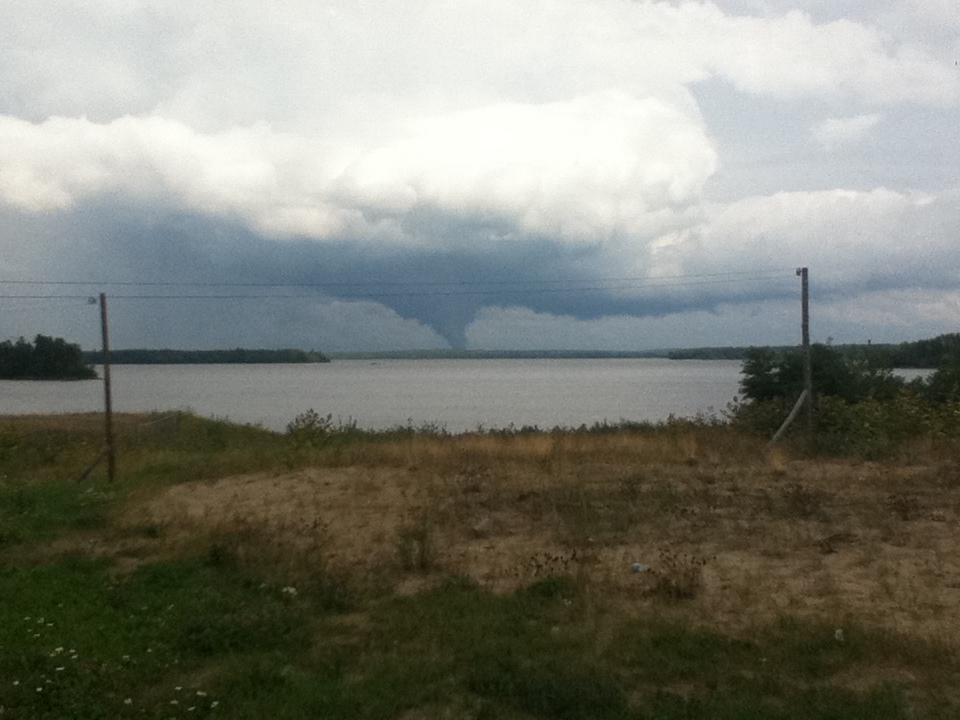
Lac Seul’s Ashley Southwind and his mother Roylene Ogemah were shocked when they first saw a tornado Aug. 16 near their community.
“My mother was the first one that saw it and she panicked,” said Southwind, a financial clerk with Lac Seul. “I was shocked at first and then I finally realized what was going on. I didn’t worry about it too much when I noticed it was going that (other) way.”
Southwind posted 10 photos to a social networking website of the tornado as it passed southeast of Kejick Bay.
Environment Canada confirmed the tornado and rated it as F0 on the Fujita Scale, with F0 being the weakest tornado and F5 being the strongest. The tornado appeared west of Dryden just after 3 p.m. and was seen near Lac Seul and Sioux Lookout later that afternoon.
Winds reached about 110 kilometres per hour but no significant damage was seen on a Ministry of Natural Resources fly-over of the area.
“It was something,” Ogemah said. “There was lots of movement, and then it would stop every now and then and start up again.”
Ogemah said there were reports of trees down in the Canoe River area, an old Lac Seul community site that still has a few residents.
Lac Seul Coun. Derek Maud also captured the tornado on his video camera after an initial shock on seeing the tornado.
“I was looking out my window and I could see it towards the Sioux Lookout direction,” Maud said, noting he first saw the clouds in a twisting motion. “It started coming down really slow. I managed to catch about 20 seconds of it on my digital camera.
“It’s something I never expected to see in my life, especially in our region of Ontario, in our back yard.”
Maud was worried at first because the band had been building a new home in the Canoe River area.
“My thoughts were at first for the guys setting up that residence out there,” Maud said.
Maud, who is also a Canadian Ranger, patrolled the community with a number of other Canadian Rangers for the rest of the day in case another tornado developed.
“We just drove around to make sure we didn’t see anything out of the ordinary coming from the south,” Maud said.
Ellen Beraldo, a Constance Lake band member visiting her sister’s family in Hudson, which is located on a lake along the southern boundary of Lac Seul, also watched the tornado as it passed east of the community.
“The clouds were just going around and around in circles,” Beraldo said. “It would clear up in the middle and then it would rotate again. It was really strange, I tell you.”
Beraldo said the clouds were an unusual greenish and bluish colour, similar to another tornado she witnessed during the early 1960s near Minnitaki Lake, southeast of Sioux Lookout.
“Around supper time we started to get strong winds and lots of thunder and lightning,” Beraldo said about the 1960s tornado. “We went in and then it went dark and then all of a sudden we heard a big noise. It sounded almost like a train going by, that’s how close the twister was.”
After the storm died down, Beraldo went back outside and was surprised by the damage the tornado had done near a neighbour’s home.
“It looked like a highway where this twister went close to their home,” Beraldo said. “You can still see all those fallen trees along the highway when you go to Sioux Lookout.”
Another tornado hit the Lac Seul area near Ear Falls in 2009. Rated as an F2 tornado, it tossed two tourist cabins into Lac Seul, killing three people from one of the cabins and injuring five people from the other cabin.
Lac Seul Elder Paddy Kenny remembers one time in the 1960s when he had to pull his boat in behind an island near the Ear Falls area as a storm approached from the far side.
“I had to hit an island one time because this little cloud came up,” Kenny said. “I had to beach my boat in behind the island. I heard it coming but it wasn’t visible. After it was over, the bay was just full of dead wood standing in the water.”
Although Kenny didn’t see a funnel cloud, he could hear the wind coming as the small cloud approached.
Kenny said he used to see trees blown down all across the North when he worked on forest fire aircraft patrols for the MNR in the 1960s.
“I would see bits of trees where something had touched down, like match sticks piled up in a circle,” Kenny said.



First Nation youth representatives are letting the world know that Indigenous people are ready to stand up and protect the land. Keira Spence, Kohen...
My home community of Attawapiskat First Nation is celebrating the annual graduations of students from Kattawapiskak Elementary School and Vezina Secondary...