



Two-thousand-one-hundred-twenty-five.
It is the population of some First Nations. It is about four percent of the total population of Nishnawbe Aski Nation.
But most startlingly, it is the number of domestic violence and sexual assault calls reported to Nishnawbe Aski Police Service from 2006-2009.
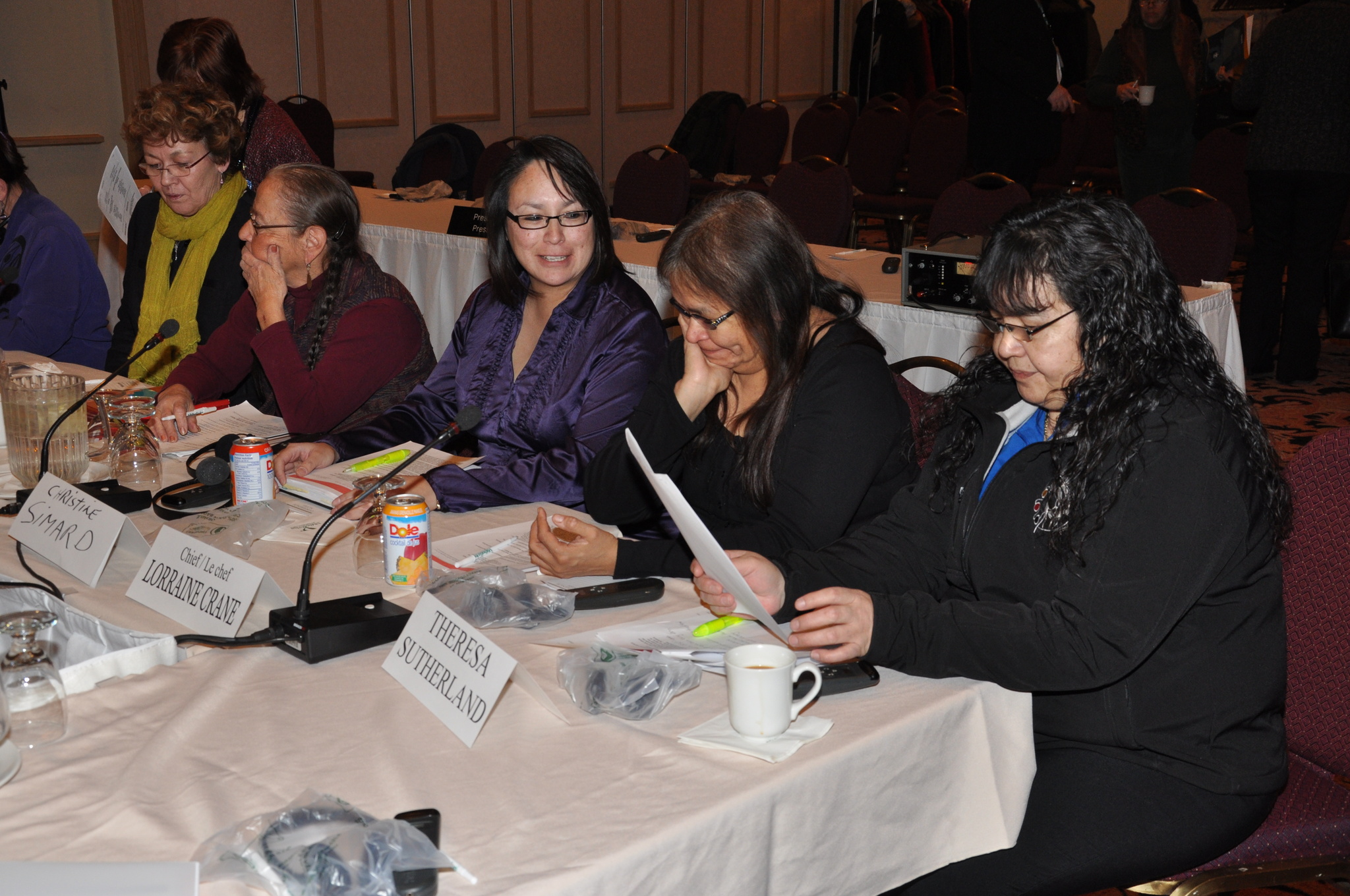
Nishnawbe Aski Nation director of women’s development Christine Simard presented that information to the Standing Committee on the Status of Women when it came to Thunder Bay Jan. 14.
“This is something that needs to be addressed,” Simard said, sitting alongside NAN Women’s Council member Theresa Sutherland and Slate Falls Chief Lorraine Crane.
Crane, also a member of the NAN Women’s Council, said violence against women is an issue in her community. Over the holidays, there were two cases she had to deal with directly as there were no police in the community at the time.
“Women who are abused, they need a place to go,” she said, speaking to the committee and three audience members. “Some women give up.”
Added Sutherland: “What these women go through is unacceptable. They are sometime unable to leave. Some don’t speak English so they can’t communicate (with the outside world) but they can’t even talk to counsellors in the community because the counsellor could be their mother, aunt or grandmother.
“I travel to communities talking to young women. I met a woman just recently, she spoke about being abused for the past 15 years. She thought it was normal.”
Ontario Native Women’s Association president Dawn Harvard said abused urban Aboriginal women have it easier than those in remote communities, though it is still relative.
“Here in Thunder Bay, an abused woman can take a cab to a shelter,” Harvard said. “Up north, it means jumping on a plane. The option to flee violence becomes more complex.”
Patricia Jurivee, executive director of Beendigen Inc., a crisis home for Native women and children in need of food and shelter when dealing with abuse, also addressed the committee.
She said there are many reasons why her 24-bed facility tends to always be full.
These include generational violence, poverty, residential school fallout and lack of parenting skills.
“We coach women to tell us what we need to hear to get them in,” she said.
Homelessness is a major issue, she said.
“We need to see changes in (low-income) housing,” she said. “There needs to be forgiveness in housing costs. High housing costs lead to other issues. Women are being accused of being poor parents because there is no food in the fridge for the kids ... but their whole cheque is going towards housing costs.
“We need a long-term solution to homelessness.”
When Marlene Pierre, of the Robinson Superior Treaty Women’s Group spoke, she did so with more than 40 years of frustrations at the “discriminatory” system which seems to be keeping women down.
“What these women have said here today will still be getting said 40 years from now,” Pierre said. “It’s the same things I said years ago when we were talking about women and women’s rights. What are you people (the government) doing that isn’t fixing things?”
While she was happy to be able to speak to the committee, she levelled sharp criticism at it.
“We can’t rely on someone (else) to share our story,” she said. “We need to do it ourselves.”


This past month, I was happy to attend two Pow Wows I hadn't been to in years. I attended the Mattagami First Nation Pow Wow and the Matachewan First Nation...
I was happy to see my home community of Attawapiskat on the James Bay coast announce the opening of the new St Francis Xavier Parish Church on August 25....