



With each name called out, one by one, another piece of history was made.
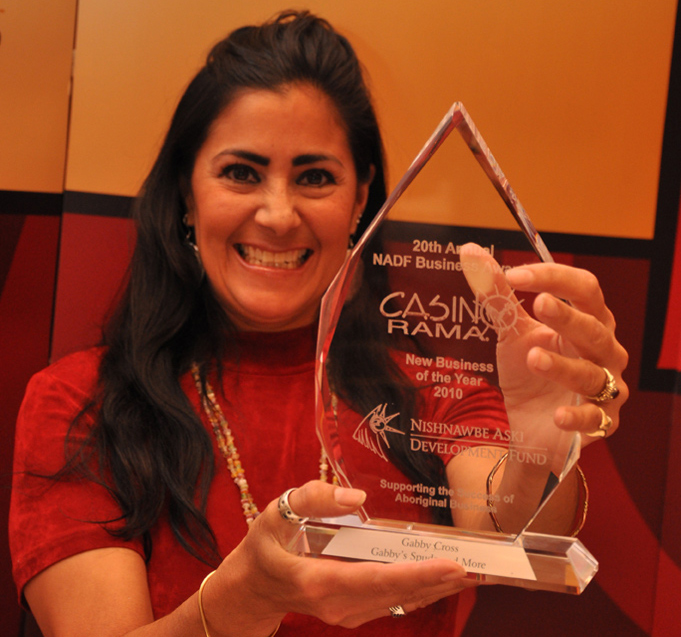
By the time Gabby Cross’ name was called out, to receive the last of eight awards to be presented that night, a feeling of unimaginable pride hit the owner of Gabby’s Spudz and More.
“Being the new business of the year, I am honoured to be the first ever recipient,” Cross said, during the Nishnawbe Aski Development Fund Business Awards Oct. 20 in Thunder Bay. “I am also so blessed to be among such elite company as the previous award winners in the past 20 years.
“From scrubbing potatoes to receiving an award, I am so joyful to be here tonight,” Cross whose family is originally from the Treaty 3 community of Sagkeeng First Nation, said.
Other award winners for 2010 include Janet Furoy, of Spa Euphoria and Wellness Retreat, as the youth entrepreneur, Dorcas Barnes, of Dorcas Therapeutic Massage, as businesswoman of the year, Clayton Clace, of Tibricor Ltd., as businessman of the year, Betrand Neilsen, of Pro Pipe Construction, the building communities award, Anemki Mountain Corporation as corporation of the year, David Fletcher, Nishnawbe Aski Nation executive director, as executive of the year, and Louise Dupuis and Pierre Pelletier, of Pelletier’s Gas Bar and Native Art Gallery, as partnership of the year.
They are the most recent entries on the list of more than 100 NADF Business Award winners, joining the likes of now-Wasaya Airways president and CEO Tom Morris, who was named businessman of the year in 1992, multiple-time winners Laureen Wasaykeesic of Mishkeegogamang and Darcy Kejick of North Spirit Lake, and lawyer Patricia Faries, the 2002 businesswoman of the year.
Since it was launched in 1991, the NADF business awards have changed and grown.
Wally Bannon, now the senior business development officer with Aboriginal Business Canada (under NADF), was a loans officer for NADF at the time of the first business awards.
“We started out with two awards – businessman and businesswoman of the year,” he said. “There was a small room at the Victoria Inn reserved for the ceremony. The audience sat at one table.”
Harvey Yesno, president and CEO of NADF, said it’s gratifying to see what the awards have become over the years.
The 2010 awards saw about 400 people attend. The event has grown from just honouring the winners into something more, he said.
“This is a chance to bring people together,” Yesno said. “A lot of networking goes on here. People have planned and scheduled meetings in Thunder Bay this week, just to be able to be here for the awards.”
While the number of awards and audience size have grown over the years, what hasn’t changed is the reason for the annual ceremony.
The value of promoting the success of Aboriginal small businesses in the region can’t be overstated, Bannon, who is from Fort William First Nation, said.
“Aboriginal people don’t tend to celebrate their successes,” Bannon said. “It is important to recognize these business leaders and hail them as role models and success stories.
“Small successes can lead to large successes. It is always our hope that the winners will ignite the business spirit in their communities.”
Yesno said over the years, NADF has reacted to the needs of the communities it serves and added new awards to honour different business sectors.
“We thought it was important to recognize the development corporations as they became more important in bringing businesses to our communities,” Yesno said. “The youth award came about because the (Aboriginal) population is so young. Our youth were getting better educations and getting more involved with business.”
The awards grew steadily in the mid-1990s.
In 1994, the first development corporation was honoured. The Kingfisher Lake Socio-Economic Development Corporation was the recipient.
In 1995, more awards were added. Peckenan Maintenance was the first partnership of the year. Emmanuel Jacob was the inaugural executive of the year.
“We continued to look at major client sectors,” Bannon said.
In 1996, a sixth award was added with Wade Cachagee earning the first youth entrepreneur award.
The inaugural building communities award was presented in 2001 with David Winters getting the nod.
Despite the growth, the awards have faced some obstacles.
“People tend to back down,” Bannon said. “They don’t want to be seen as further ahead of anything else. One gentleman in Fort Hope has been nominated several times and he won’t accept the nomination.”
But as the awards have grown, so have the number of nominations from the region. Bannon said the awards are open to all Aboriginal businesses in northern Ontario.
“When we were concentrating on just the NAN area, our nominations were down,” he said.
Bannon said the diversity of businesses being honoured is a testament to good ideas being pursued.
While gas bars and grocery stores are important businesses to pursue, so are massage salons, hairdressers, restaurants, hotels and computer technicians.
“What I always try and tell people is go with your passion,” Bannon said. “It’s not a bad thing to do what you love to do. You spend 86,000 hours working in your career, do what you like.”


This past month, I was happy to attend two Pow Wows I hadn't been to in years. I attended the Mattagami First Nation Pow Wow and the Matachewan First Nation...
I was happy to see my home community of Attawapiskat on the James Bay coast announce the opening of the new St Francis Xavier Parish Church on August 25....