



Aboriginal people are overrepresented in the HIV and AIDS epidemic in Canada.
For cases in which ethnicity was provided, the rate of reported AIDS cases in Canada among Aboriginal people rose from 1.2 per cent in 1993 to 13.4 in 2003.
In 1998, 18.8 per cent of positive HIV tests were among Aboriginals. This rose to 25.3 per cent in 2003.
Youth made up 31.4 per cent of positive HIV tests among Aboriginal people from 1998 to 2003.
AIDS Thunder Bay education communication coordinator Bob Manson said the numbers are likely much higher now because ethnicity is not always included in paperwork.
“What we need to look at is ways to make people safe and prevent the spread of AIDS,” Manson said. “Aboriginal people have the same risk factors as everybody else.”
AIDS and HIV can only be spread through contact with five bodily fluids: blood, semen and pre-ejaculatory fluid, vaginal fluids, breast milk and rectal secretions, Manson said.
“There is not enough concentration in our fluids to get infected,” he said. “The virus needs a host to survive.”
The two biggest factors in the spread of HIV and AIDS remain intravenous drug use, when people share needles, and unprotected sex.
“When you are looking for your next fix, you’re not thinking about making the right healthy decision,” Manson said, describing the thought-process of a drug user.
Apart from sharing syringes and needles themselves, other drug paraphernalia can actually spread AIDS, HIV and other diseases.
“If you have an open sore on your lip and you and your friend are sharing the same pipe, you can spread it as well,” Manson said.
Other factors in spreading AIDS and HIV include having another active sexually transmitted disease which could produce open sores on your genitals which can act as doorways for HIV to enter your body and using non-sterile tattoo or piercing needles.
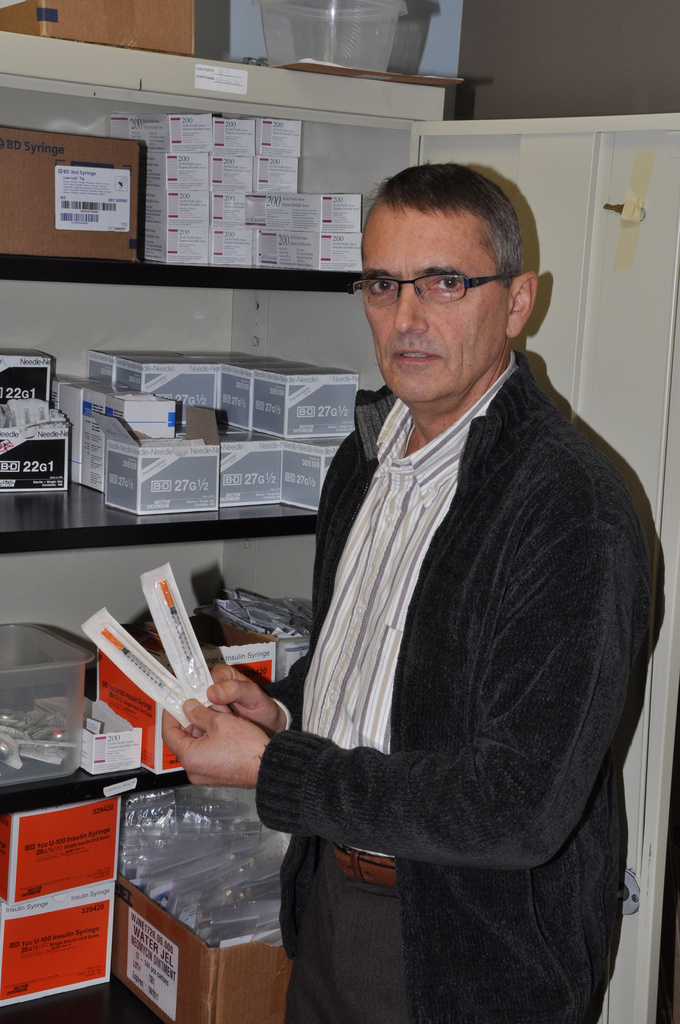
To help prevent the spread of these diseases – Thunder Bay has a rate three times greater than the provincial average for co-infection of hepatitis C and AIDS – AIDS Thunder Bay hands out 600,000 needles a year in partnership with the local health unit.
“We have to do our part in helping prevent the spread of disease,” Manson said. “This is service without judgement. All we want to do is make sure people are safe.
For the same reason, kits are also available with needles, cookers, pipes, cotton swabs and other artifacts.
“It costs about $750,000 or more to treat an AIDS patient in their lifetime with drugs and other healthcare costs,” Manson said. “It makes economic sense to hand out needles.”
Manson said the disease can be spread even through a contaminated arm tie wrap.
“It is important to not use any of the same artifacts as someone else,” Manson said.
Condoms are also available through AIDS Thunder Bay and the health unit.
Manson said controlling the spread of AIDS is a matter of education.
“People need to be able to talk about it,” he said.
He said it is OK for a boyfriend or girlfriend to ask their lover to get a test done to be sure they are not infected.
“Twenty-seven to 35 per cent of people that are infected in Canada don’t know they have AIDS,” Manson said. “If you knew, you would likely take precautions to protect your partner and family. Take care of yourself and empower yourself. Don’t rely on someone else to go get tested. Put the onus on yourself to be able to say ‘I don’t have AIDS.’”
There remains no cure for AIDS but because people are able to live longer, fuller lives through anti-retroviral drugs, there doesn’t seem to be as much fear of AIDS.
“It used to be you would die within two years (if you contracted AIDS),” Manson said.


This past month, I was happy to attend two Pow Wows I hadn't been to in years. I attended the Mattagami First Nation Pow Wow and the Matachewan First Nation...
I was happy to see my home community of Attawapiskat on the James Bay coast announce the opening of the new St Francis Xavier Parish Church on August 25....