



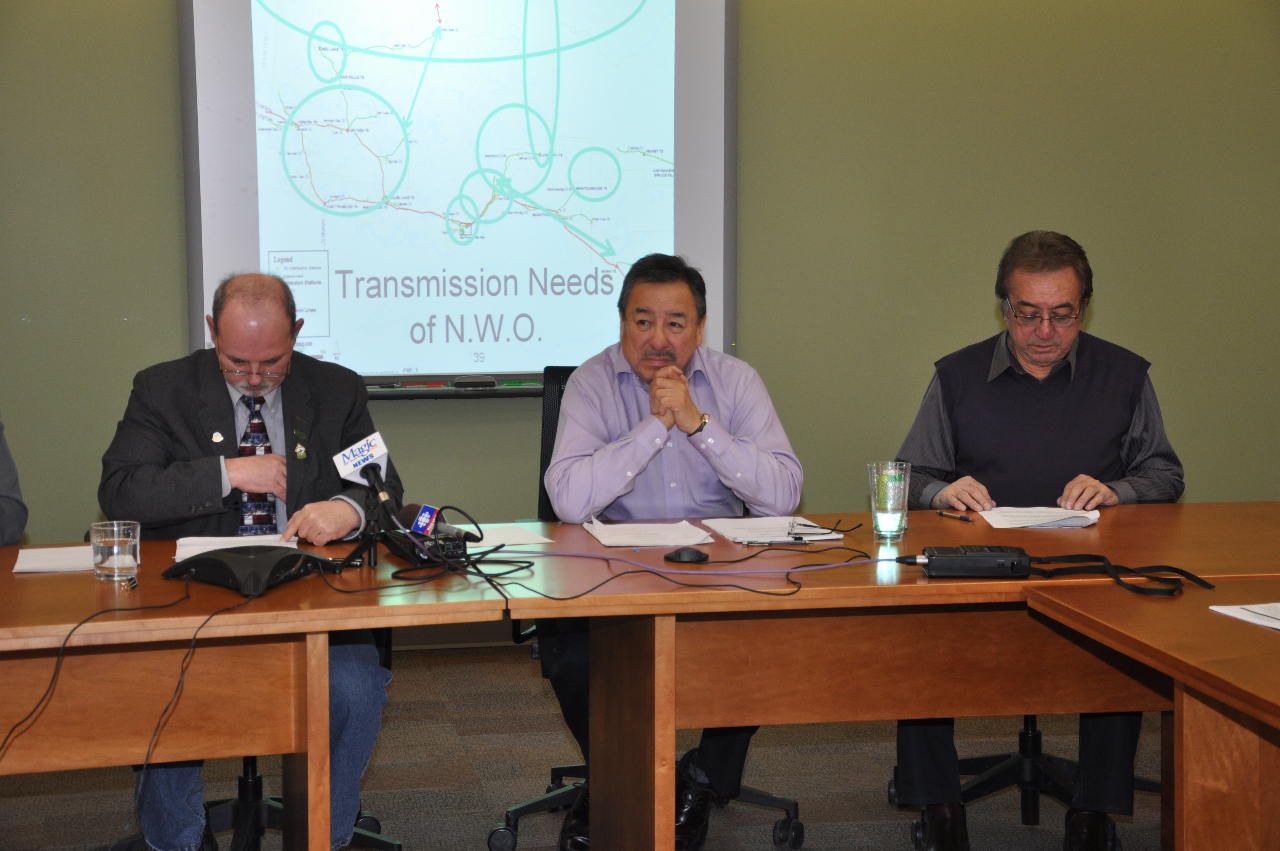
If resources are going to leave the Ring of Fire, First Nations are going to benefit from it, said David Paul Achneepineskum, CEO of Matawa First Nations Management.
Achneepineskum said if the chromite is to be mined and processed, it should be done so within the territory of the Matawa people, since the minerals fall within the traditional lands of Webequie and Marten Falls First Nations.
“We are not going to allow anyone to take these minerals and process them somewhere where our people will not benefit,” Achneepineskum said, speaking following the signing of a memorandum of understanding between Lake Nipigon First Nations and Matawa First Nations Feb. 11.
He specifically supported the bid of Aroland First Nation and the Municipality of Greenstone to have the 300 megawatt processing facility built in their region to allow maximum benefit to the First Nation.
Construction elsewhere in northwestern Ontaio would be OK but is not the preferred choice, he said.
Aroland Chief Sonny Gagnon echoed Achneepineskum’s comments.
“The chromite will be taken from the traditional territories of the First Nations people; it only makes sense that we, the First Nations people, must have direct benefit from the construction and operation of the chromite processing facility.”
The location of the processing plant for the Ring of Fire minerals – believed to be one the richest untapped deposits in the world – is one of three key aspects of the agreement between the Lake Nipigon and Matawa chiefs.
Another part of the agreement includes a possible hydro transmission line from the town of Nipigon to the Little Jackfish project, a proposed hydroelectric project near Lake Nipigon. The groups have also agreed to explore economic and infrastructure opportunities.
While Aroland and Greenstone continue to lobby for the processing plant, Cliffs Natural Resources, an international mining company and supplier of natural resources to the steelmaking industry, released a project description Feb. 4 of its Cliffs Chromite project in the McFaulds Lake area near Marten Falls and Webequie.
Bill Boor, Cliffs president of ferroalloys, said his company continues to conduct pre-feasibility studies on the project. If it’s achievable, chromite ore would be mined from the Ring of Fire and then transported to a processing facility. To determine if the project is economically viable, Cliffs is using Sudbury, Ont., as a ‘base case’ scenario for the processing plant.
Boor said his company still plans to meet with officials in Sudbury, Timmins, Greenstone and Thunder Bay to look at options in different locations. But the price of power in Ontario remains a major barrier to construction.
“At current provincial power rates, there isn’t a location in Ontario that is economically viable for Cliffs to build the (ferrochrome production facility),” he said. “The viability of an Ontario-based (processing plant) and final selection of the location are still being evaluated.”
The lack of available low-cost energy in northwestern Ontario has prompted Harvey Yesno, president and CEO of Nishnawbe Aski Development Fund to join discussion. He is calling on the province to reduce power rates to keep the processing plant in northern Ontario. Yesno believes several Aboriginal businesses will benefit from the development of a processing plant.
“The province of Ontario needs to be more visible and aggressive in tackling the power rate issue that is threatening the viability of a production facility in northern Ontario,” Yesno said, “because any final decision to locate the ferrochrome production facility outside of the province negatively impacts Aboriginal business in the region.”
However, he said issues of hydro and hydro rates goes well beyond the business world.
“Many people now understand what our remote communities are facing on a regular basis when we can’t develop economically because of the chronic lack of electricity,” he said. “For example, we don’t have sufficient power to expand a motel, never mind a 300 megawatt processing facility.”
Yesno said NADF has conducted several studies to try and move forward with electricity transmission and the development of renewable energy projects in the north. He said the province can’t afford to sit idly by.
“We welcome a more proactive role by the provincial government on this issue now, because there is too much at stake,” he said.
While the cost of hydro has been making headlines in recent weeks because of Cliffs’ announcement, a Thunder Bay group has been loybbying for hydro improvements in northwestern Ontario for several years.
Ron Nelson, president of the Northwestern Ontario Municipal Association, said energy issues are relevant to the entire northwest region, including municipalities, businesses and First Nations. He said speaking with a common voice is better than speaking alone on the energy issue.
He said changes are needed in the power system to attract “new mines, forestry operations and manufacturing facilities, as well as improve our residential communities, both municipal and First Nation.”
“The common theme from all of us is that the northwest region of Ontario needs its own plan for electrical generation, transmission and distribution,” Nelson said. “It also needs its own plan for energy pricing.”
One major area of concern is that the Ontario Power Authority is responsible for planning transmission lines that move large amounts of power from one region to another while Hydro One is responsible for the lower voltage distribution lines which are used to supply electricity directly to the local distribution companies that deliver power to customers.
“In southern Ontario, the distribution lines are relatively short, serving relatively smaller but very densely populated areas,” Nelson said. “Here in the northwest region, however, our distribution lines are hundreds and hundreds of kilometres long, crossing vast stretches on sparse, if any, population, and constitute, in effect, our entire transmission grid.”
He cited several hydro issues which require attention.
These include instability, unreliability and lack of capacity in the service to both Red Lake and Greenstone; the lack of capacity in the transmission station serving the City of Thunder limiting economic growth in the city; the lack of a transmission line to connect the Nipigon area with the proposed Little Jackfish generation project and a proposed 100 megawatt wind farm on the eastern side of Lake Nipigon; and the lack of capacity to provide electrical power to remote First Nation communities from access points including Red Lake, Pickle Lake and Longlac.
A more extensive transmission network would help reduce high hydro costs in First Nations, Nishnawbe Aski Nation Grand Chief Stan Beardy said. It would also ease reliance on burning diesel fuel for electricity.
At current rates, Beardy said it costs three times as much for hydro in remote First Nations as it does in Thunder Bay.
“It is important to reduce the number of communities dependent on diesel generation for electricity as the growth in housing and other services is often restricted by the absence of an adequate energy supply,” Beardy said.


This past month, I was happy to attend two Pow Wows I hadn't been to in years. I attended the Mattagami First Nation Pow Wow and the Matachewan First Nation...
I was happy to see my home community of Attawapiskat on the James Bay coast announce the opening of the new St Francis Xavier Parish Church on August 25....