



Out for a fishing trip last fall, a few anglers from Kitchenuhmaykoosib hooked into something even better than a trophy fish.
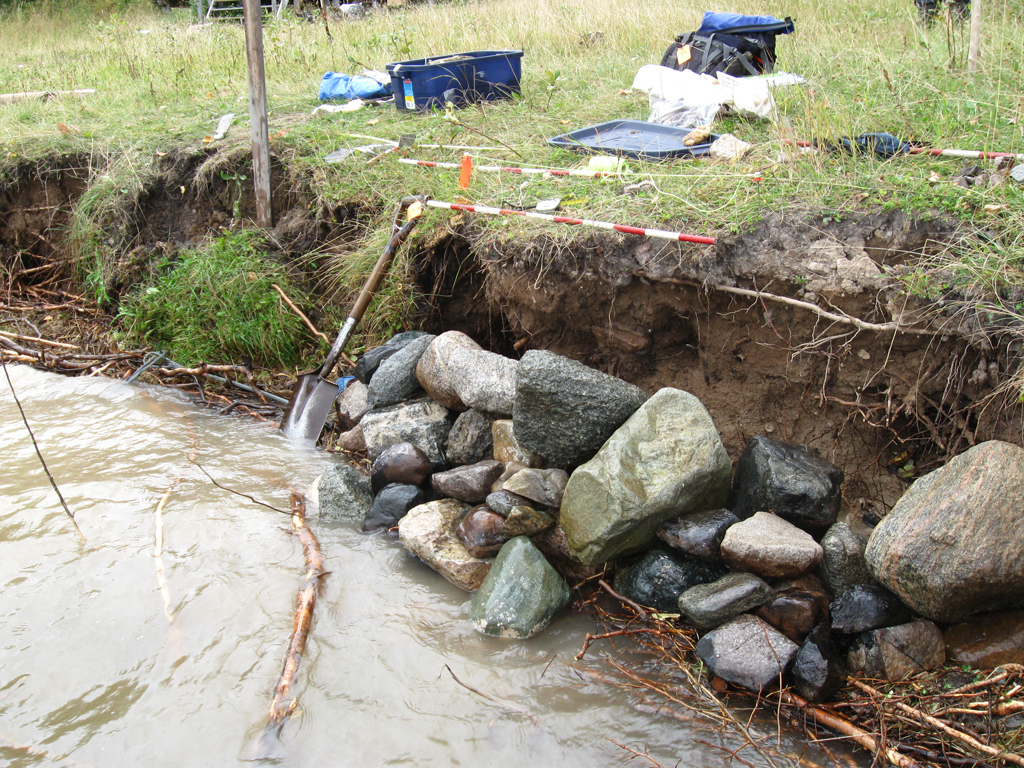
At the mouth of Bug River, the men discovered human remains that date back about 4,600 years.
Since the bones were discovered in September and recovered for study at the end of that month, Lakehead University professor Scott Hamilton has been studying the skeletal remains.
“A huge amount of information can come from the study of these human remains,” Hamilton said. “I’m quite happy Chief (Donny) Morris called me to get involved.”
Community members are quite excited to find out what Hamilton has found out, said Coun. Jack McKay.
“We are very supportive of the research he is doing,” McKay said. “We want to find out information about the remains. We were surprised at the age of the bones.”
Hamilton said the discovery by community members, some of which was buried up to 30 centimetres under the surface, was a wonderful fluke, the equivalent of finding a needle in a haystack.
“There seemed to a lot of factors that came together to make this happen,” Hamilton said, including having observant anglers spotting the bones and being willing to notify chief and council instead of just ignoring the find.
McKay said the water level played a huge factor in the find.
“The lake was really high,” he said. “It washed out the banks of the lake.”
The effect of the waves continually striking the banks caused the soil and gravel to wear away and the bones to protrude, McKay said.
This is the second major discovery of ancient bones in the community.
In 2004, during a heat wave, the banks of Big Trout Lake receded and a pair of residents noticed a bone sticking out of the ground. After careful searching, more of the skeleton was unearthed.
After community consultation was performed, Hamilton was invited to unearth the remains and removed them for scientific study.
They were eventually reburied, as will the more recently discovered bones.
Hamilton expects this to happen in the coming months.
But before that happens, there’s more research to conduct, Hamilton said in his basement office at the Thunder Bay university.
He and colleagues are attempting to extract DNA from a bone and a tooth.
“If we can acquire viable DNA, it opens a whole new door to study,” Hamilton said. “It could be a revolutionary opportunity for study. The real question is what if. What could this lead to?”
Should the DNA tests prove successful, there is a real possibility he could trace the DNA and find out the two skeletons were in some way related, separated by several generations.
Hamilton has already made several preliminary discoveries.
He has found the skeleton belonged to a man in his late-30s or 40s. He was about 165 centimetres (five foot six inches) tall with a “very, very robust muscular build,” from canoeing and other activities reliant on strong upper bodies.
Testing has also found the man enjoyed a fish-based diet along with traditional fare like caribou.
“The teeth give us a lot of information,” Hamilton said.
“There are no cavities. That typically means there was little or no starch in their diet, little vegetables and a lot more meat.”
The teeth also show signs of wear.
“This is mechanical damage,” Hamilton said. “Chips in the teeth show a lot of use.”
Hamilton explained much like people do today, this man likely used his teeth for constructive purposes like biting, stripping and grinding materials which would also account for more wear.
I was happy to see my home community of Attawapiskat on the James Bay coast announce the opening of the new St Francis Xavier Parish Church on August 25....
Attawapiskat First Nation wrapped up another successful Kattawapiskak Keekehwin Gathering for the community. The week-long event was held from August 2 to 8...