



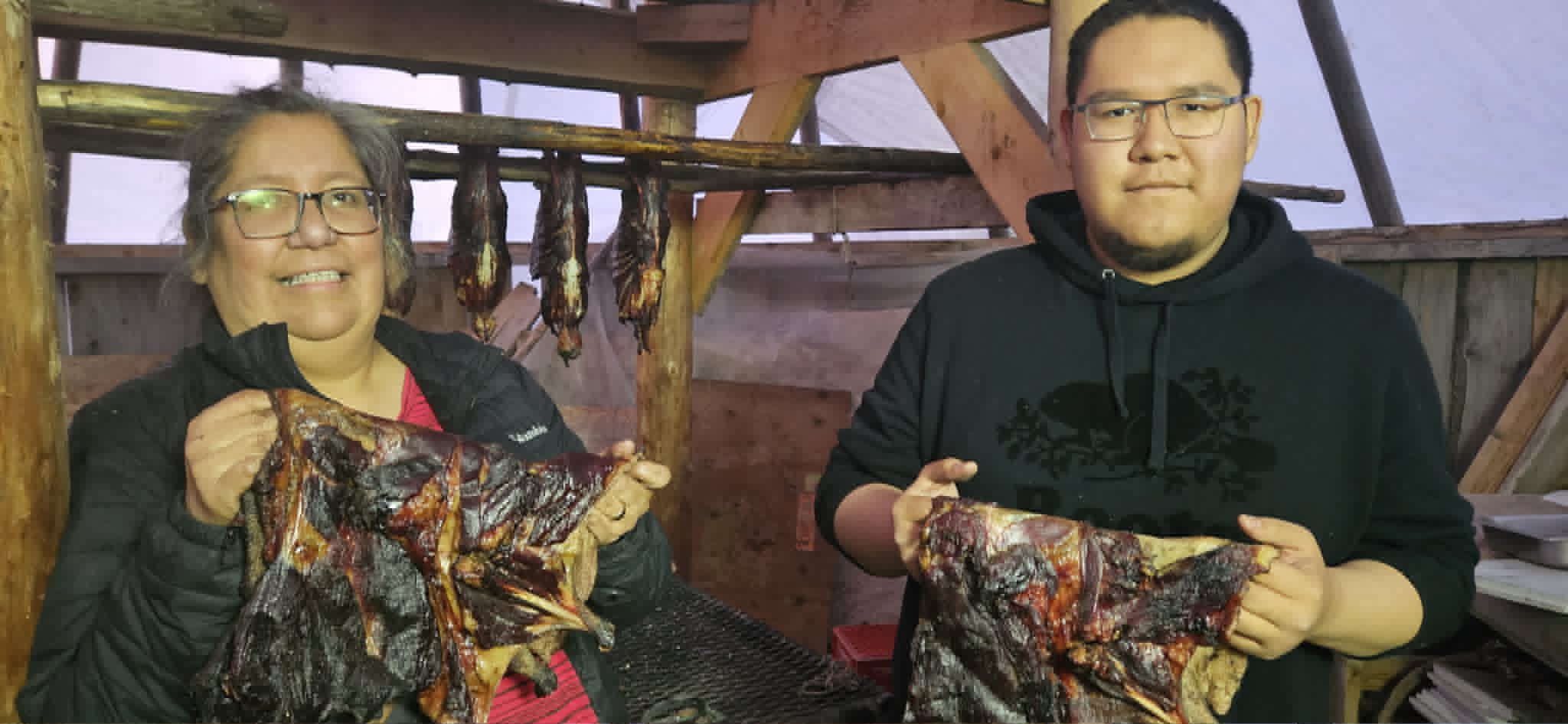
The traditional custom of making Nah-Mesh-Tek, smoked goose is a practise that has been handed down for generations in Attawapiskat First Nation on the James Bay coast. Here we see Janie Wesley with her nephew Orion Kataquapit as they hold up their latest batch of Nah-Mesh-Tek, smoked goose. Photo by Brian Wesley.
I was happy to see my nieces and nephews in Attawapiskat taking the opportunity to learn about the traditional practice of making Nah-mesh-tek, the Cree word for preserving and smoking geese. This is a food preparation method that our people in the north have used for thousands of years and it is an essential way to gather and store large stocks of food for the long term.
My nephew Orion Kataquapit spent the past week learning from his aunt, my older sister, Janie Wesley, in her permanent Meegwam, our Cree word for what is commonly known as a teepee. I was happy to hear from my sister that she also took time to teach our nieces, Kaitlyn and Julie Kataquapit, the practice of smoking geese. Janie said she was happy to teach and show others how to do all this. Our mom, Susan Kataquapit, had taught all of us how to do this work when we were children. Janie added that our grandmother Louise Paulmartin/Rose, our mom’s mother, had also taken extra time to give her these skills years ago.
Janie and her husband Brian Wesley are great knowledge keepers in our home community. Brian was close to his mother, Margaret Wesley and his grandparents, Anna and Willie Wesley and he learned a great deal of our community’s traditional knowledge and history from them. It’s great to see both of them sharing these traditional practices with others, as it not only shows a young generation the practical task of preparing and storing food but also exposes everyone to our Cree language, phrases and stories from the past.
It’s really special for me to hear about all the activity and teaching happening in my family this year. Even the geese that were gathered were special. Orion gathered his birds from a hunting ground called ‘Kamotayak’, on the south shore of Akamiski Island, where his grandfather, my father, Marius Kataquapit, hunted years ago. Julie and Kaitlyn brought back geese further north on James Bay near the lands where their grandmother, my mother, Susan (Paulmartin/Rose) Kataquapit, was born and raised.
My sister Janie showed our nephew and nieces the hard work that goes into creating Nah-mesh-tek, ‘smoked goose’. Once geese are gathered, plucked, cleaned and gutted, they are ready to be made into Nah-mesh-tek. These freshly made geese are butchered in such a way as to separate the majority of the flesh from the bone in two large pieces. One piece would be nothing but a large, single, continuous section of meaty flesh, held together by sinew and skin and the other piece would be the main section of backbone and rib cage. The flesh undergoes further processing with a special cutting technique to stretch it as thin as possible. At the end of it all, there would be a large sheet of goose flesh that is about two or three feet long. The goose flesh would then be draped on a wooden rack suspended over the fire. At the same time, the coals are carefully managed to create a smouldering fire that produces plenty of smoke, slowly cooking and drying the thin layers of flesh.
When we were children, we would watch our mother fill several racks inside the Meegwam in this manner. She often reminded us that as carefully and expertly as she cut the geese, when she was a child, her Elders would cut the flesh so thinly that it would produce great long sheets of goose flesh to be smoked. Back then, they would set up two or three levels of racks to hang as much food as possible for smoking and preservation. There was no refrigeration back then and this was the best way to preserve food for the long term. The spring goose hunt and the smoked goose provided enough food to last everyone through the summer months until the fall.
My sister Janie Wesley gave me a quick lesson on the types of smoked goose that our people on the James Bay coast traditionally made. Nah-mesh-tek was the main type. There was also Moo-koo-peh-see-gun, which is prepared in the same way but it is first boiled in water, then smoked for a short time. This type offers the benefit of producing tastier, juicier meat with a bit of smoky flavour. Another type is See-koo-peh-see-gun, which is prepared in a similar way to Moo-koo-peh-see-gun but it is quickly stored away in containers and then preserved in goose fat. Oos-kan-nee-gun is the second half of the Nah-mesh-tek, as this is just the carcass being smoked. As little food was wasted and just smoking the bones with their remaining flesh was a delicacy many people enjoyed.
In addition to learning the basics of making Nah-mesh-tek, Orion, Kaitlyn and Julie also had the opportunity to listen to and learn about the language, words and phrases used in our Cree language during these traditional practices. When I spoke with Orion about his experience, he said it was important to him to learn about these traditional practices. I couldn’t help but feel that his parents and late grandparents would also be happy to hear about everything he is learning. Our whole family is happy to know that these young people are learning about our heritage and language.

First Nation youth representatives are letting the world know that Indigenous people are ready to stand up and protect the land. Keira Spence, Kohen...
My home community of Attawapiskat First Nation is celebrating the annual graduations of students from Kattawapiskak Elementary School and Vezina Secondary...