


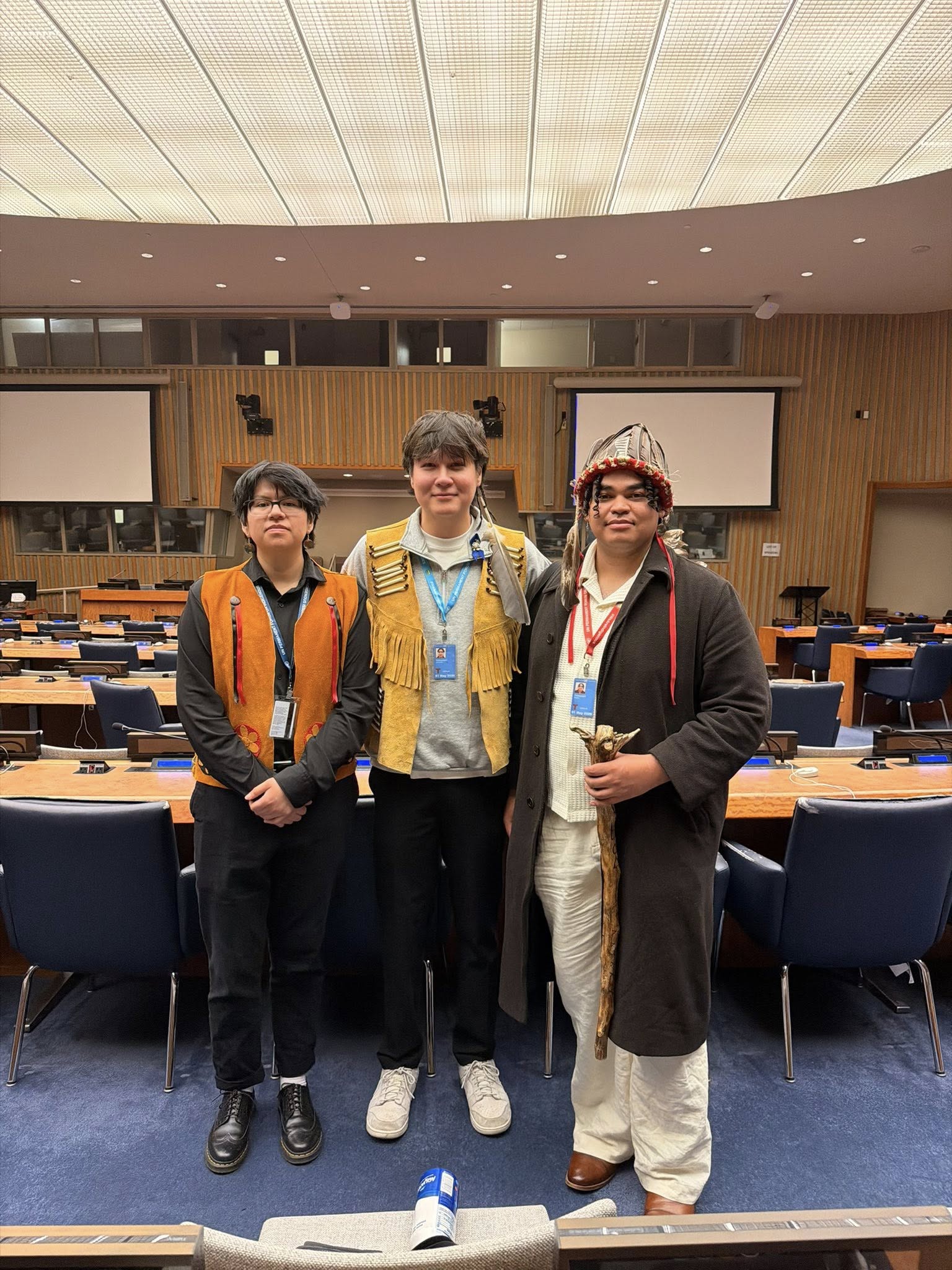
Northern First Nation youth addressed the United Nations Permanent Forum on Indigenous Issues (UNPFII) Twenty-Fifth Session which was held at the United Nations headquarters in New York from April 20 to May 1, 2026. Pictured (L-R) at the UN in New York are: Kohen Mattinas, Lac Seul FN / Constance Lake FN; Jeronimo Kataquapit, Attawapiskat FN and Ramon Kataquapit, Attawapiskat FN. (Photo provided by Jeronimo Kataquapit)
I was proud to see First Nation youth representing our northern homelands on the international stage this past month at the United Nations. Jeronimo Kataquapit, Ramon Kataquapit, Kohen Mattinas and Ryan Fleming participated in the United Nations Permanent Forum on Indigenous Issues (UNPFII) Twenty-Fifth Session, held at the United Nations headquarters in New York from April 20 to May 1, 2026. This year, the event brought together more than 1,000 participants, including Indigenous peoples and political representatives of member states and United Nations entities.
The forum was developed by the United Nations to address the concerns and rights of the world's indigenous peoples. The forum is meant to give indigenous people a voice on the international stage. It is estimated that there are more than 370 million indigenous people in some 70 countries worldwide. According to the United Nations, Indigenous Peoples represent less than six percent of the global population but protect nearly 80 percent of the planet’s biodiversity. In many instances, industry and natural resource development occur in what is often identified as uninhabited or remote lands, when in fact, Indigenous people often live on or use these same lands and have been for thousands of years.
Jeronimo Kataquapit, a member of Attawapiskat First Nation who comes from a family of traditional hunters and gatherers, founded the ‘Here We Stand – Call To Action’ group as a way to bring attention to his people’s connection to the Attawapiskat River and to push back on the planned development of the ‘Ring of Fire’ mining area in northern Ontario. He wanted to take direct action to protect his homeland in the north and in the summer of 2025, he and his family documented a 400 km freighter canoe trip from the mouth of the Attawapiskat River to the areas where proposed mining development is set to take place. They were joined by supporters from Neskantaga FN located on Attawapiskat Lake. They have since set up a permanent camp at this location to continue their protest against Ontario’s Bill 5 and Canada’s Bill C5, which aim to fast-track mining development in the north.
To support this growing movement against less-regulated and fast-tracked mining development in the north, other youth groups have joined the cause. Okiniwak is a First Nation youth movement founded by Ramon Kataquapit, Attawapiskat FN and Kohen Mattinas, Lac Seul First Nation. Their youth movement has been at the forefront of rallies and events that raise public awareness of First Nations' displeasure with government legislation that would affect the future of First Nation communities.
Jeronimo had the opportunity to address the gathering on the last day of the forum on April 29. In his address, he asked ‘How will Canada keep its international climate commitments as a global climate leader in the face of the Ring of Fire development on the carbon-rich and sensitive ecosystem of the peatlands, while simultaneously honoring its commitments to First Nations people?’. He reminded everyone with a belief and tradition in his family but one that is also common in many Indigenous cultures, by saying, ‘Where I come from, the land, the water, the earth is not given to us by our parents, it is loaned to us by our children’.
Earlier on April 23, Ramon Kataquapit also addressed the gathering to state that ‘Youth have the power to make change’ and that ‘we have the backing of our leadership in Canada and that they know we are here and everyone knows we are here to implement UNDRIP (United Nations Declaration on the Rights of Indigenous Peoples), even though government wants to supersede and go past what ‘free prior and informed consent’ is’.
In his address on April 20, Ryan Fleming, Attawapiskat FN, shared a common concern repeated by First Nations and First Nation youth, ‘What we are seeing is chronic underfunding, jurisdictional exclusion, and the failure to implement Treaty relationships in practice.’
In their address to the forum on April 28, Kohen Mattinas pointed out how indigenous people and especially indigenous youth are often left out or not given enough of a voice in resource development on their homelands. Kohen stated ‘Indigenous youth and remote First Nations are often missing and the voices most impacted. The consequences of this is evident in many of our communities. In the Hudson and James Bay lowlands, known to us as the breathing lands, Canada is advancing critical mineral development in the Ring of Fire through legislation such as Canada's Bill C5 and Ontario's Bill 5. These processes accelerate decision-making while bypassing First Nations governance systems and disregarding treaty relationships with indigenous rights holders’.
I was very honoured to see these youth speak on behalf of our people to tell the world about what is happening in our homelands. It is humbling indeed to hear our First Nation youth speaking as often and as loudly as possible to protect the animals, the water, and the land, not just for Indigenous people but for everyone. Kitchi-Meegwetch Jeronimo, Ramon, Kohen neshta Ryan (Thank you very much Jeronimo, Ramon, Kohen and Ryan).

First Nation youth representatives are letting the world know that Indigenous people are ready to stand up and protect the land. Keira Spence, Kohen...
My home community of Attawapiskat First Nation is celebrating the annual graduations of students from Kattawapiskak Elementary School and Vezina Secondary...