


Violence has no place in the lives of Canadians.
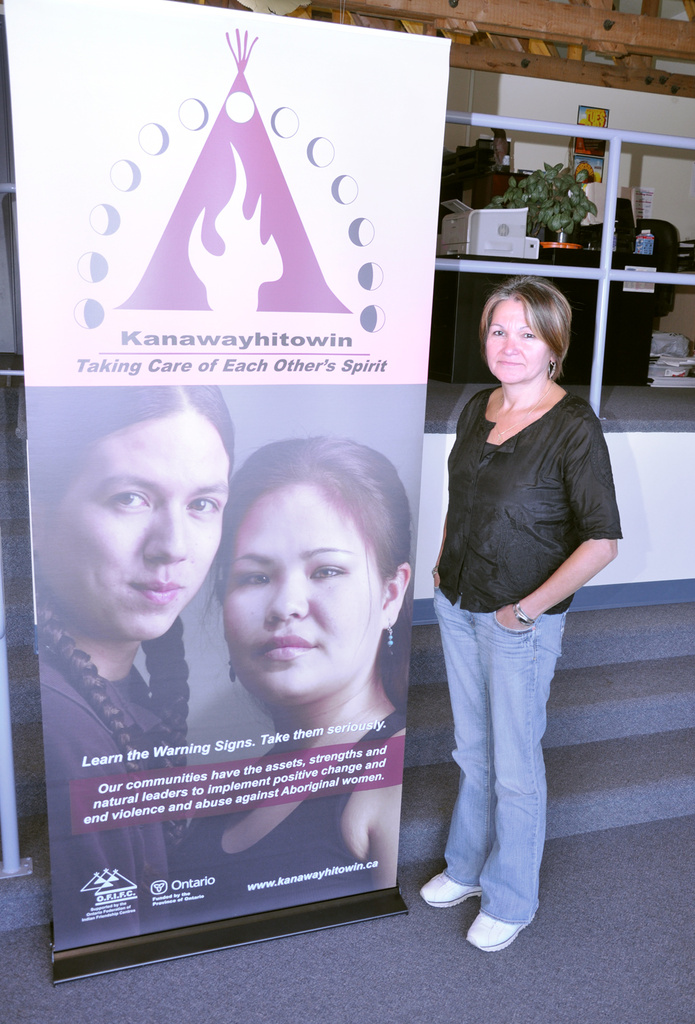
Kanawayhitowin: Taking care of each other’s spirit was recently launched to raise awareness about the signs of woman abuse in First Nations communities, so people who are close to an at-risk woman or abusive man can provide support, explained Roseanna Hudson, chairwoman of Aboriginal Domestic Violence Committee in Thunder Bay.
Hudson and her daughter Raven McCarthy shared their own story about the cycle of abuse after the Kanawayhitowin program – which focuses on ending the isolation abused women feel, emphasizes the empowerment of Aboriginal men to take responsibility and make change and provides information about warning signs and safety planning – was launched.
Hudson knows abuse first-hand.
“I grew up in a community where domestic violence was kept silent,” she said, not wanting to disclose the community. “Everyone knew about it but no one did anything about it.”
Her grandmother had to flee an abusive relationship when Hudson was young.
“My mom lived in the same home and married a man who was also violent,” Hudson said. “I remember times when she had black eyes and no one even asked her what happened.”
Although the last thing she wanted was to marry a man like her father, Hudson said it’s exactly what happened.
“I didn’t want my kids growing up in a home where their mother was being abused by their father,” she said.
Hudson and her first husband married in 1975 and she left him in 1978.
“Thinking back, there were signs (he would be abusive),” she said. “He punched me when we were dating. I pretended it didn’t happen. I wanted it to work out with him.”
Being physically and mentally abused left a huge impact on Hudson.
“I had to change the way I responded to conflict,” she said. “I wasn’t strong enough physically so I used my mouth instead. I said some very hurtful things.”
This was the case in a new relationship she formed with a non-abusive man who would eventually be her second husband of 21 years and counting.
“Initially, my mouth got me into trouble,” she said. “I didn’t know what I was saying was causing so much hurt. I came to realize I was carrying my parent’s behaviour into my relationships.”
That may also be the case in McCarthy’s case.
“When I was younger, I don’t recall witnessing physical violence,” she said. “What I do remember is a lot of yelling.
Instead of saying it was my turn to do the dishes, she would yell at me to get up and do them.
“I understand now why she was like that.”
McCarthy has found herself on both sides of the abuse spectrum.
She was abused by boyfriends but took them back despite the abuse which included punches, choking, cigarette burns and forced sexual acts. She was abused an average of every 1.5 weeks, generally on places on her body most people wouldn’t see.
“In my mind, I was thinking it was so wrong but he begged for forgiveness (and she took him back,)” McCarthy said.
In the midst of the abuse, McCarthy’s friends stopped coming around.
“They told me it was because of him,” she said. “He cost me my friends and I shied away from my parents. I isolated myself to protect myself from the shame.”
Eventually, she ended the relationship.
Other relationships followed, with varying degrees of abuse, and she met her future husband in Edmonton when she was 25.
She had been living with a friend and started to focus on herself with self-help books, counselling and learning about depression.
The relationship was good, but McCarthy would lash out at her future husband with words.
“I started become abusive towards him,” she said, which prompted a return to counselling. “I was just a mean person to my husband.”
Abuse comes in many forms, the women said.
“We need to stop being silent,” Hudson said. “Thanks to this program, I think more people will have the tools they need to help someone who is being abused. There are services available for the victims and the abusers as well.”
There are several reasons people don’t leave abusive relationships, Hudson said.
These include lack of money, lack of skills to start a new life and self-esteem.
“People need to remember physical scars are easy to heal, emotional ones are not,” Hudson said.
For more on the program see http://www.kanawayhitowin.ca. Resource materials are available online.
This past month, I was happy to attend two Pow Wows I hadn't been to in years. I attended the Mattagami First Nation Pow Wow and the Matachewan First Nation...
I was happy to see my home community of Attawapiskat on the James Bay coast announce the opening of the new St Francis Xavier Parish Church on August 25....