



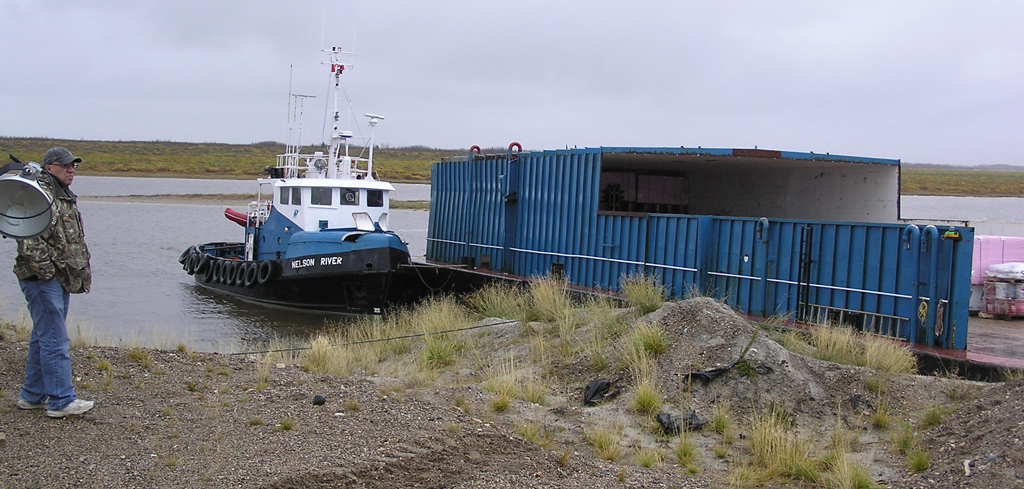
Fort Severn residents have new hope for good food, healthy eating and local economic activities since the arrival of two band-chartered Moosonee Transportation Hudson Bay barges at the end of September.
Lower freight charges for fuel, food and materials mean the community of 400 people can begin to again utilize land-based food resources, as well as imagine and pursue a better lifestyle for themselves.
The first barge arrived on the evening of Sept. 29 and the second barge was ready to pull in after the first was finished unloading Oct. 1.
At one time, barges were able to drive upriver the entire six miles to the community from the coast.
But the aging Severn River is growing increasingly shallow and at present the barges must land within sight of Hudson Bay four miles downriver from the community landing.
The two barges were the first to arrive since 2008. Since then, the community has seen skyrocketing costs for necessities such as gasoline.
When supplies, such as gas, delivered by barge or on winter roads run out, gasoline is air delivered. As a result, the cost during much of 2009 and 2010 for gas was $3.75 per litre
The significantly shortened winter road season in 2009 further contributed to the financial challenges for both the First Nation and its members, as well as for outside service agencies planning any capital or program delivery improvements in Fort Severn.
“It was really hard on people,” explained Fort Severn Chief Matthew Kakekaspan. “People didn’t get to go anywhere,” on the land for food, fuel wood gathering or cultural activities.
Access to country food resources to obtain necessary protein is essential for healthy eating on limited incomes in remote communities.
It is near impossible to properly feed a family on a typical food budget with groceries purchased exclusively from Northern Store outlets because of high prices, a reality in many remote communities.
The answer to healthy eating for most families is to supplement their protein from healthy land-based food resources.
But high fuel costs can often prevent most land-based activities.
Costs rise waiting for barge shipment
Higher costs for basic essentials during 2009 contributed to the band initiating a fuel wood program for community Elders. The band also implemented a First Nation subsidized, discounted barge freight rates on certain goods for other shippers. Kakekaspan and council decided to offer discounted rates on certain supplies so greater savings could be passed along to Fort Severn consumers.
One example of the subsidy is lower fuel freight rates offered to the Northern Store for their gasoline haul. By agreeing to the discounted freight rates, the Northern committed to offering lower cost fuel to band members. It is expected barge-delivered gasoline will now cost around $2 a litre, compared to an estimated cost of $2.50 a litre if the barge freight discount was not in place.
Band staff are responsible for all aspects of maximizing the barge capacity and making it a cost-effective exercise at $153,000 for a single barge shipment.
These responsibilities include: scheduling the barge charter; pre-payment of all charter costs; arrangements for the ordering, payment and shipping to Moosonee of all band-required goods; and facilitating and billing at $0.50 a pound for all other barge shipments by community members and outside agencies which need to economically ship goods to Fort Severn.
A single barge shipment is normally sufficient to supply the community with a year’s worth of fuel, dry goods, building materials and any new vehicles the band, community members or outside agencies may require.
The 2010 season required two full and separate barge loads to meet the community’s needs.
The community expects the next barge in 2011.


I recently lost my cousin Joey Okimaw. We were childhood friends who had grown up together since we first entered grade school in Attawapiskat. Joey’s...
I was surprised recently when I saw my relatives in my home community of Attawapiskat First Nation on the James Bay coast were still having to fetch water...