



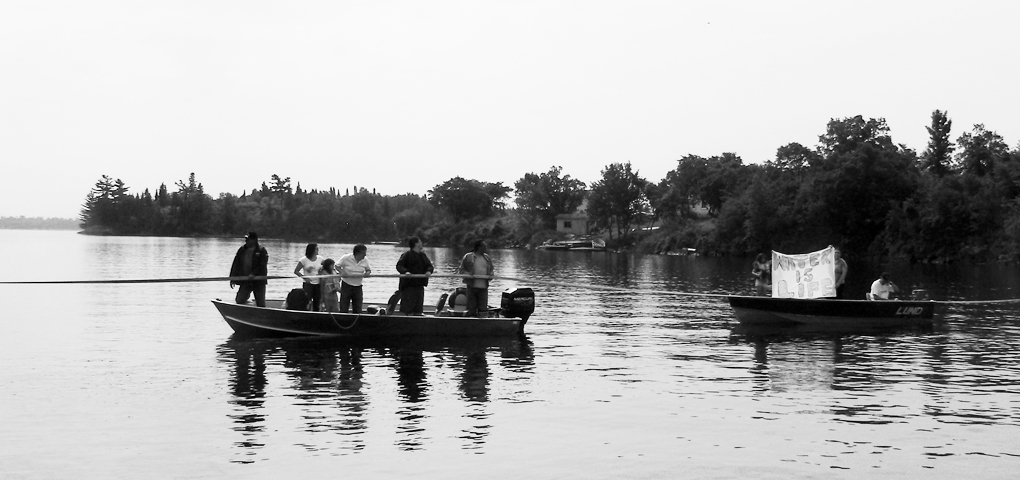
Iskatewizaagegan (Shoal Lake #39) First Nation has mobilized community members at the mouth of the Shoal Lake watershed where the City of Winnipeg gets its water.
Community members at the mouth of the lake are creating a presence until they get the respect they deserve, said Shoal Lake chief Eli Mandamin.
“And they are determined to stay there until the issue is resolved,” Mandamin said.
For more than a century the province of Manitoba and the City of Winnipeg have been granted free access to fresh water running from Iskatewizaagegan traditional territory without proper discussion, consent or compensation to the First Nation, the community claims.
Shoal Lake is on both sides of the Ontario and Manitoba borders, with the community residing on the Ontario side and its traditional territory extending into Manitoba.
In July, Winnipeg and Manitoba agreed to split the cost of extending Winnipeg’s water and sewage-treatment services and hopes to sell some of these services to neighbouring communities.
Iskatewizaagegan asked Manitoba Premier Greg Selinger and Winnipeg Mayor Sam Katz to postpone their water extension plans but, according to the First Nation, their concerns were ignored.
The occupation coincides with a recent four-day, 300-kilometre walk that began in Shoal Lake #39 and ended at the Manitoba Legislature in Winnipeg with a protest for the community’s water rights.
The walk began Oct. 3, the anniversary of the signing of Treaty 3 in 1873. There were 30 community members who participated in the walk and the numbers would reach up to 50 people that would join the walkers briefly in areas along the TransCanada Highway to Winnipeg. The group averaged 50 kilometres a day, reaching the Legislature building Oct. 7.
“We stayed at roadside motels along the way. We would not retreat the eagle staffs and the community’s flags from the highway, their presence at all times was a priority on this walk,” Mandamin said.
In past years Iskatewizaagegan has staged protests along the TransCanada Highway and at the waterbed on their territory during Canada’s National Day of Action held in June.
This year the community decided to walk to Winnipeg because both provincial elections in Ontario and Manitoba were happening at the time.
“Both elections were going on and it’s time for the governments to wake up to these issues. The timing was right to finally send a message to the legislative building, the message that had to be delivered was that this was the last of free water they’d be getting from this province,” Mandamin said.
Iskatewizaagegan said the community has experienced impacts on their wild rice harvesting and lakeside erosion because of the water extraction.
Also, every time the community attempts to undertake development projects that would benefit and improve the lives of its members by growing the community’s economy, the City of Winnipeg raises objections saying development would degrade the water quality. Mining for gold is one of the efforts the community would like to develop, but is unable to.
“The strength that Winnipeg and Manitoba has in our territory is too much now,” Mandamin said.
To date the deputy minister in Manitoba has responded to their recent outcry for consultation and compensation and would like to meet with the chief and council. Mandamin said he is in the process of setting up other meetings with Manitoba and is expecting re-elected Manitoba premier Greg Selinger to agree to sit down for discussions.
“We want a meeting with the premier to put good political will together that will be needed to start a process to deal with the water issue,” he said. “Also, we are asking for (a memorandum of understanding) to be signed to show the political willingness to work with the community.”
Mandamin said the community is also doing more legal work to enhance the position that they are taking and to enhance the terms and processes they’re asking for and giving to the province and Winnipeg.
“There’s a lot of work that needs to be done when you make statements and take a stand like this,” he said. “Our reserve has never signed any agreement, so we still own the waterbed located on our territory. They’ve been flooding us for the past 100 years, if you want to continue flooding us we won’t be overlooked anymore.”
The walk to Winnipeg and the recent mobilization at the mouth of the lake are in protest of Manitoba and Winnipeg’s plan to continue extracting water from Iskatewizaagegan’s territory without consent. The community is also asking for $124-million per year for water taken from their territory.
“What we’re after in Shoal Lake is what everybody else wants out there in their territories, that is a better equality of life of our kids and our future,” Mandamin said.



Maachestan, the Cree word for the annual spring river ice breakup, is happening all along the James Bay coast. This is a very important time of year for...
I was proud to see First Nation youth representing our northern homelands on the international stage this past month at the United Nations. Jeronimo...