



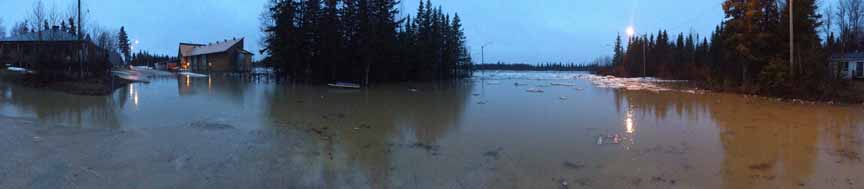
Rising waters following the break up of the Attawapiskat River has led Attawapiskat First Nation to evacuate some of its residents while other James Bay communities go back to normal following another spring thaw.
The community of Attawapiskat evacuated more than 400 of its most vulnerable residents –mostly Elders, chronic care patients and those with small children – last weekend after water levels rose near the community.
The First Nation declared a state of emergency due to the threat of flooding and more than 150 residents were flown to Thunder Bay while 100 residents were flown to Geraldton and around 200 residents were evacuated to Greenstone. Another 60 residents who were evacuated due to sewage backups in early May were flown to Fort Frances.
And while residents observed water levels lowering on May 13, the community’s flood coordinator warned that ice and water still coming down the river remains a threat.
“It all depends on where, there’s different water levels depending on the location: in front of the community, up the river and west out in the bay,” said Sally Louttit, the community’s flood coordinator. Louttit said they are continuing to monitor the water levels on the ground and by air.
In Kashechewan, most of the 1,000 or so residents who were evacuated to Greenstone, Thunder Bay and Kapuskasing returned home by May 10 after the community leadership deemed the threat of flooding to be minimal.
However, Hosea Wesley, a band councilor, said the state of emergency remains in effect because 40 homes that experienced sewage backup still pose a health risk.
More than 250 residents who were evacuated in early May because they were affected by the sewage backups remain in Kapuskasing.
Although the First Nation has acquired some water pumps, one of the water stations is still inoperable.
Work has begun in removing drywall, insulation, washers, driers and personal belongings from the affected homes. Before the basements could be restored, the drains will need to be excavated and check-valves will need to be installed to prevent future backups. Additionally, weeping tiles will need to be excavated and inspected.
Wesley estimated that it could take up to six weeks for the homes to be repaired and cleaned so that the remaining evacuees can return home.
In Fort Albany, the community’s flood watch team “demobilized” for the season and stated the community will go back to normal. As of May 13, the causeway between Sinclair Island and the mainland was available to cross by vehicle or foot.
In Moose Factory and Moosonee, water levels along the Moose River system began to decline on May 6. The following day, emergency flood coordinators announced the flood threat level was greatly reduced.
The town of Moosonee lifted its state of emergency and all 240 vulnerable residents who were evacuated returned home.



This past month, I was happy to attend two Pow Wows I hadn't been to in years. I attended the Mattagami First Nation Pow Wow and the Matachewan First Nation...
I was happy to see my home community of Attawapiskat on the James Bay coast announce the opening of the new St Francis Xavier Parish Church on August 25....