



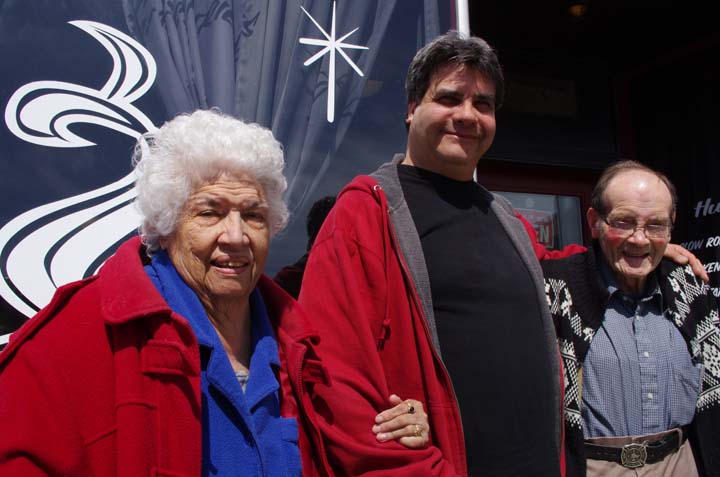
Seventy-seven years ago, Wilda Walmark’s parent packed up their children and became one of the last families to leave their traditional lands in Quetico Provincial Park.
Walmark, the daughter of Esther Powell and granddaughter of Mary (Marie) Ottertail from Lac La Croix, still remembers her childhood in the park fondly.
“We could swim all the time and we had the lake to skate on in the winter,” Wilda said. “And then one day they were packing up everything. I asked them what they were doing and they said we were packing up, we were going to town.”
Wilda said her father had the family “primed up” and ready to move to Port Arthur, now the north side of Thunder Bay, for her to attend St. Joseph’s Indian Residential School in Fort William at age seven.
“My dad was a ranger, which was kind of nice because we had everything,” Wilda said, describing her life on the land in Quetico Park. “I didn’t like to go because we did everything. I was seven already, and I could shoot.”
Wilda said her mother also didn’t want to leave her home in Quetico Park.
“She didn’t like it when we left, but my dad said we had to go to school,” Wilda said.
Wilda said there were about four families with “quite a few” children living on the small lake her family lived on in Quetico Park.
“We lived mostly scattered around,” Wilda said. “We used to have great fun there. Everybody seemed to get along well up there — if somebody was short of something, somebody would take it from their own bowl, load up and everything would be alright.”
Wilda said her mother and grandmother had both grown up in Quetico Park and knew how to make a living from their traditional lands.
“My mother was a dead shot,” Wilda said. “She was a swimmer like you wouldn’t believe. She swam out to the island because there was this one animal out there and she wanted it. She didn’t kill it — she kept it alive for a long time until we left.”
Wilda’s father worked with the Ontario Department of Lands and Forests until the family left Quetico Park in 1946.
Quetico Park was first established as the Quetico Forest Reserve in 1909 and then as Quetico Provincial Park in 1913.
Although the Anishinabe had called the area home before contact and a reserve had been established in the park after Treaty #3 was signed in 1873, the original inhabitants of the park were gradually forced out, beginning in 1910 when the provincial government forced Sturgeon Lake Ojibway Reserve 24C band members to break camp on Hunter’s Island, located within the park.
The Sturgeon Lake band members eventually settled in other Treaty #3 communities in the area, including Lac La Croix, located on the southwest corner of Quetico Park, and their reserve was declared abandoned by the federal and provincial governments in 1915.
The minister of Natural Resources eventually apologized in 1991 in the Ontario legislature for the province’s actions and promised to improve economic and social conditions in Lac La Croix.
Wilda’s son John Walmark, a Thunder Bay police constable, said his grandfather had to self-identify as a non-native to obtain work with Lands and Forests back in the 1930s.
“Different times,” John said. “He said one time that if he had self-identified himself as Aboriginal, he would have been deemed unreliable and he would never have been able to work.
He wrote a letter on his deathbed identifying himself as Ojibwa-Mohawk from the Durham region of southern Ontario.”
John said his grandfather felt the livelihood of family members would have been “adversely” affected if he had identified as First Nations.
“Which is really sad,” John said. “But it’s good to keep that letter in the future to know that at one time that is the way things were, to make it better.”
John returned to Lac La Croix in 2012 after meeting Councillor Kalvin Ottertail, one of his family members still living in the community.
“He invited me to come home,” John said. “I wanted to reconnect with the family and I wanted to go out there and learn more about that family.”
So he attended Lac La Croix’s annual traditional powwow in late August, the first family member to return to the area since Wilda and her family left in 1946.
After setting up his tent along the lakeshore on the powwow campground, John met some of the community Elders, including Clifford Whitefish.
“When I said I was the great grandson of Marie Ottertail, he said ‘welcome home,’” John said.
“We started talking and someone brought me a family tree (going) right back to seven generations (to) the origin of our side of the family: Blackstone was the woman’s name and our male ancestor was Johnny Ottertail.”
John said the community had no idea what happened to his family after they left Quetico park.
“A lot of people couldn’t figure out where the Caribou name connection was and they couldn’t figure out how the Powells were connected to the community,” John said.
“By sharing our stories of Saginaw and of the Gunflint trail area of Minnesota, that’s what started filling in the gaps as far as the Caribou family and the Powell family. They weren’t sure if they were visitors or if they were family — now they know for a fact that they were a family.”
The next morning John did some early morning ceremonies with the Elders and he was invited to join the Lac La Croix community drum during the powwow.
“We received a teaching that the drum is over 150 years old and was originally brought to the community from the Saginaw area by the Ottertail and Powell families.”
Wilda attended high school in Port Arthur after finishing residential school and eventually studied nursing in Chicago, where she worked as a nurse for a number of years before returning to Port Arthur.
Wilda said her interest in nursing likely came from her parents as her mother was a traditional healer back in Quetico Park and her father had been a medic during the two world wars.
“My mother was practically a doctor,” Wilda said. “Dad went to two wars and I was really amazed at how much he could do.”
When she moved back to Port Arthur, Wilda continued with her nursing career after doing some of her nursing studies over again. She married Ian Walmark, who she first met in high school, in 1960.




This past month, I was happy to attend two Pow Wows I hadn't been to in years. I attended the Mattagami First Nation Pow Wow and the Matachewan First Nation...
I was happy to see my home community of Attawapiskat on the James Bay coast announce the opening of the new St Francis Xavier Parish Church on August 25....