


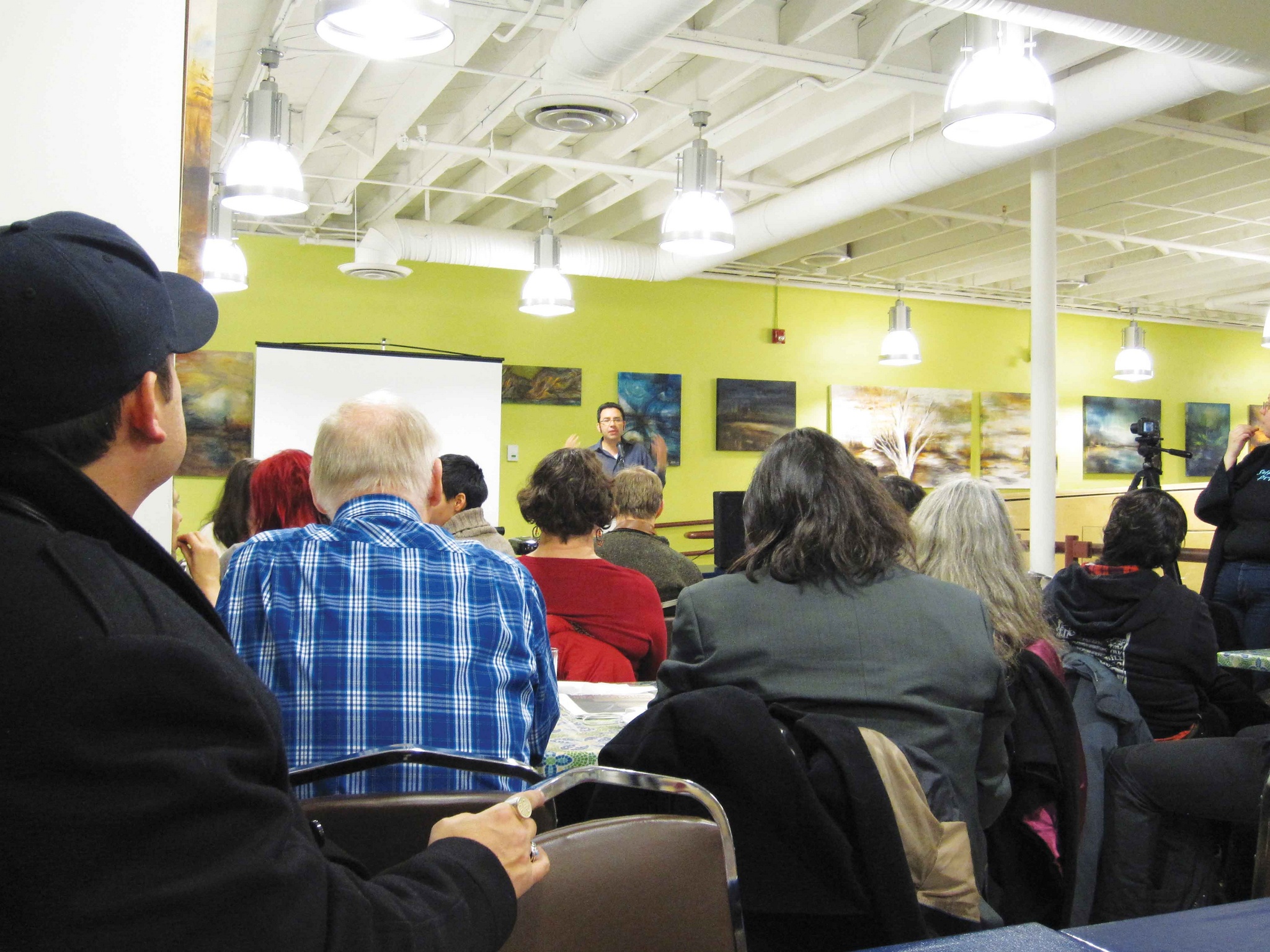
The 2nd Manitoba Indigenous Writers Festival hosted several emerging Indigenous writers from across Canada, including several youth from northwestern Ontario in January.
Inuit youth writers Tanya Roach and Jordan Campbell, Quebec writers Natasha Kanape Fontaine (Innu) and Louis-Karl Picard-Sioui (Wendat), and three writers from Toronto Melissa Compton (Mi’kmaq), Jamie Morin, and Jesse Thistle (Metis), were invited to this year’s festival.
Northwestern Ontario youth Matt Goodchild (Pays Plat First Nation), Kassidy Armstrong (Garden River First Nation) and Batchewana First Nation’s Amy Boyer and Theodore Syrette were participants in last year’s spring Creative Writer’s Workshop held in Winnipeg. The workshop focused on writing from 3rd and 4th generation residential school survivors.
Katherena Vermette, an award-winning poet and member of the Aboriginal Writer’s Collective, hosted the festival this year.
“All in all, the festival was great,” Vermette said. “The audiences were huge and full of life! You can’t ask for anything better than that.”
This year the festival included panels on Indigenous Children’s Literature, Indigenous Graphic Novels, and readings by Indigenous writers from across the country.
The festival opening was hosted by Niigaanwewidam Sinclair and also featured the launch of the new book Writing for Change, which included work by the members of the northwestern Ontario youth who attended the Creative Writing Workshop.
Author Richard Van Camp was also on hand to present the Zoe Hopkins movie Mohawk Midnight Runners, which was based on his story Dogrib Midnight Runners.
Van Camp hosted private workshop with all of the youth who were invited to the festival this year.
“He was very bonkers,” Theodore Syrette laughed. “He was open and honest, the ultimate free thinker.”
Syrette took part in Van Camp’s workshop, and said that he was “very forceful to get his message across about his stories.”
“I think he was delightfully entertaining with his comedy,” Syrette said. “He has such a heart and passion to his creativeness, to how he engages with people. He gets your attention.”
Working with Van Camp was one Syrette’s highlights of this past festival. Syrette read some of his work at the festival, an act he said he was still nervous about.
“I think any artist who is willing to share their heart has a sense of anxiety. If you don’t feel nervous, you’re not pushing yourself hard enough,” Syrette said.
He said it was good to see familiar faces in the crowd while he read his work, like Vermette, Rosanna Deerchild, Shayla Elizabeth, (who are both poets and were workshop facilitators at the spring workshop) and Renate Eigenbrod. Eigenbrod is a professor, and head of the Department of Native Studies, at the University of Manitoba.
Eigenbrod was instrumental in bringing this year’s guests to the festival, and also worked with Cheryl Suggashie, member of Pikangkum First Nation, to create the Creative Writing Workshop.
“I think it is widely known that residential school experiences have created harmful intergenerational impacts, in different ways depending on the circumstances and the severity of the trauma experienced by the survivors,” Eigenbrod said.
Eigenbrod’s academic work focuses on literature by Indigenous authors.
“I came to understand the potential for recovery and reclamation expressed in creative writing and how the indirect, non-threatening way of storytelling in poetry, novels, short fiction, and plays may assist a writer in working through issues shrouded in silence,” Eigenbrod said.
Vermette hopes that the emerging writers who were invited learned something this year, “or at least had a good time.”
“They’re getting more comfortable with their roles as storytellers,” Vermette said of the writers who shared their work during public readings. “Therefore they’re able to take more risks and dive a little further.”
Vermette feels it is important for people to engage in something like the writer’s festival because “we all need to have an avenue to vent and figure out what we’re doing and why.”
“Writing is a great way to do that,” she said. “For our young people, finding something to help cope with life and articulate feelings is so important.”
Writing was a way for Vermette herself to help cope.
“It’s a good art to try, even if it’s not for you,” Vermette said. “It’s always surprising what comes out!”



This past month, I was happy to attend two Pow Wows I hadn't been to in years. I attended the Mattagami First Nation Pow Wow and the Matachewan First Nation...
I was happy to see my home community of Attawapiskat on the James Bay coast announce the opening of the new St Francis Xavier Parish Church on August 25....