


Nishnawbe Aski-Nation (NAN) released a report containing 13 recommendations to help improve the safety of the community of Thunder Bay. The report is based off of a community safety forum that was held on Jan.15 regarding recent racially-motivated incidents in the city.
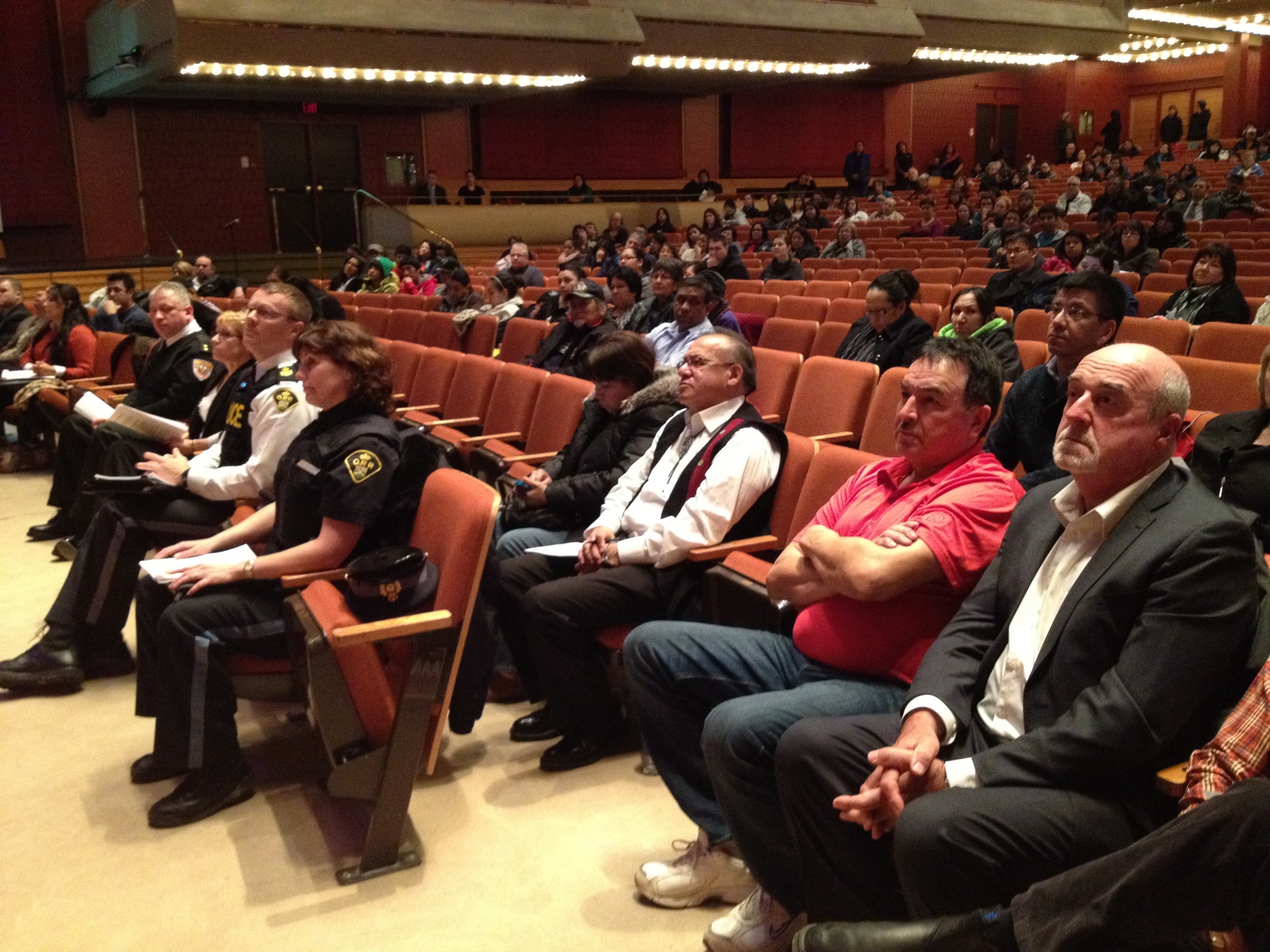
The forum was attended by over 200 representatives of Aboriginal organizations, municipal politics, law enforcement, and the general public. The forum was inspired by concerns over community safety after a brutal sexual-assault that was allegedly racially-motivated, as well as an incident where a young First Nations student was dropped off by a police officer on the outskirts of the city of Thunder Bay and made to walk back home.
Some speakers at the forum were Chief Peter Collins of Fort William First Nation, Thunder Bay mayor Keith Hobbs, NAN Grand Chief Harvey Yesno, Deputy Grand Chief Alvin Fiddler, Thunder Bay Chief of Police J.P. Levesque, and Northern Nishawbe Education Council (NNEC) Executive Director Norma Kejick.
“A major safety concern in Thunder Bay, especially as of late, is the safety of women and children,” said Collins. “All citizens are looking to ensure that their children are safe and secure. To achieve safety and security, the importance of building relationships cannot be understated.”
The forum was held in order to begin meaningful dialogue on the topic of community safety, and encouraged all participants to become active in helping make the city of Thunder Bay a safer place.
Mayor Hobbs explained that his plan when he became mayor for a safer community has so far “been a failure.”
NAN Deputy Grand Chief Alvin Fiddler said that the relationship between the First Nations community and police was broken. He also expressed concerns about the education of First Nations youth.
“A troubling pattern has emerged where parents from remote communities are pulling their children from urban high schools for fear of their safety. Stories like this make our work more urgent. The dialogue that we have must be brutally honest and all concerns must be on the table,” said Fiddler.
Kejick said that one First Nations community has removed all of their students from school in the city due to safety concerns.
“Students have to constantly defend who they are, and some have been told that they are unwelcome at Intercity Shopping Centre. Students are already dealing with the struggles of being a teenager, and are seeing things that many have not dealt with prior to moving to Thunder Bay,” Kejick said.
Some of the audiences’ suggestions included ideas like cross cultural training not only for police but also for city employees such as bus drivers, harsher punishments for hate-crime related sexual assaults, support systems for students coming in from remote communities, and increased First Nations presence in public services.
The 13 recommendations in the report fall under five areas: general, law enforcement/justice, community building, communications, and education.
The report reiterates that the community safety forum is just the beginning of a meaningful dialogue between the entire community in order to promote safety and civility, as well as repairing damaged relationships.
The report states that “the next steps will involve more community engagement through more open forums and feedback received through the email safetyforum@nan.on.ca . Recommendations from future forums and those received by email will be reviewed on an ongoing basis. The goal is to identify tangible steps that can be taken towards a safe community.”
Safe Streets Safe Community
Recommendations
General
1.



This past month, I was happy to attend two Pow Wows I hadn't been to in years. I attended the Mattagami First Nation Pow Wow and the Matachewan First Nation...
I was happy to see my home community of Attawapiskat on the James Bay coast announce the opening of the new St Francis Xavier Parish Church on August 25....