



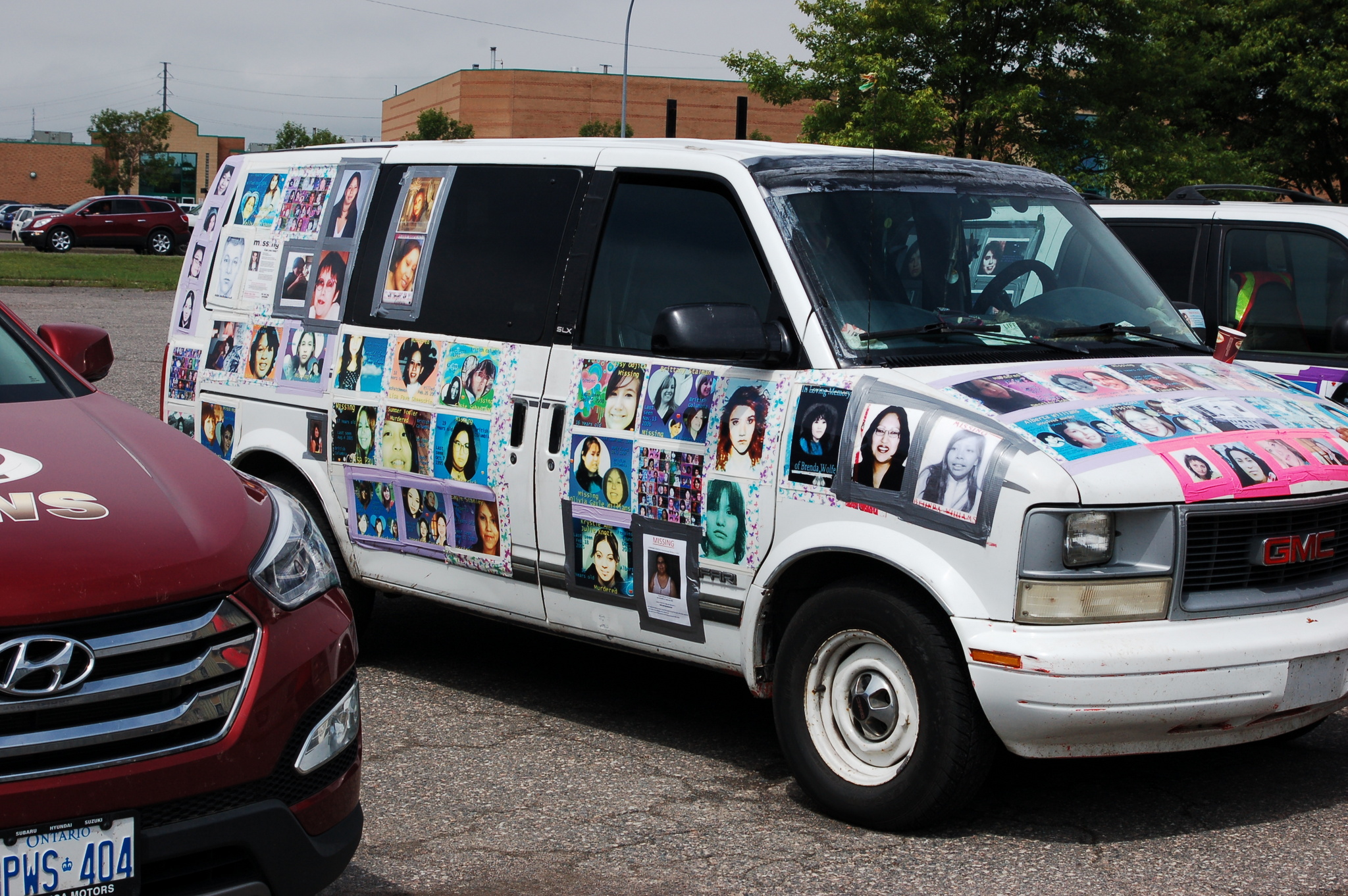
Tears 4 Justice, previously known as Walk 4 Justice, arrived in Thunder Bay on the weekend of July 20 and held an event at the Labour Center on July 22.
The group of eight volunteers are currently walking across Canada in order to spread awareness on the issue of missing and murdered Aboriginal women.
The group was met and housed by local supporters, including Sharon Johnson. Johnson has also been walking in memory of her sister, Sandra, whose murder in the East End of Thunder Bay in 1992 is still unsolved. Johnson hosts the annual Full Moon Memory Walk in Thunder Bay.
“It’s important to support these walks because it’s hard to lose a family member that way. It’s like a wound that never heals,” Johnson said.
Tears 4 Justice has been through Thunder Bay four times during the walk’s five years. Gladys Radek first came up with the idea of walking across Canada for missing and murdered Aboriginal women after being disillusioned with the results of a meeting she attended with the national chiefs in Gatineau, Quebec in 2008.
Becky Bigcanoe, one of the walkers, said that the government keeps denying repeated calls for a national inquiry into missing and murdered Aboriginal women. Recently, the Conservative government denied another request from the premiers for a national inquiry on the issue.
Bigcanoe said that it is hard to get people to become involved in events relating to missing and murdered Aboriginal women if the people have never experienced a similar loss.
Mabel Todd, who was 73 when she became involved in Tears 4 Justice five years ago, said an Elder told her that when a loved one dies an unnatural death, the pain of that loss will remain.
“When I am walking, I always pray for the women and children, men and youth too,” Todd said.
During the Tears 4 Justice meeting in Thunder Bay, walkers and local supporters took time to share stories.
“The newspapers don’t cover it, we don’t get coverage unless we tell them to come out,” Aleck Clifton said to the small crowd. “That’s why I walk, for all the people who don’t have a voice.”
Gloria Johnson, sister to Sandra and Sharon, expressed the same sentiment.
“The media needs to be here,” she said. “When Sandra was found, the papers portrayed her as a street-worker. She was only 18, she was here for school. She was just doing things that kids normally do when she was taken.”
“When I do talks like this, I’m always envisioning full tables, a full house,” Gloria said.
“I don’t know how to make people understand what it’s like, the loss of a loved one.”
Bigcanoe said that people should not accept the stereotyped images of women who go missing as being those involved in the sex trade and therefore not as valued. “Some women are forced into a lifestyle because of poverty,” she said.
William Dick, one of the walkers, was also involved in the lifestyle at an early age. He lost his mother when he was young.
“I grew up in a really wrong way,” Dick said. “I entered the sex trade at a young age, experienced a hard road. If I had a mom, I think that she would have come and got me. A lot of kids have been through what I’ve been through, but nobody really notices.”
Radek lost a niece along the infamous Highway of Tears in BC. She said the incident opened her eyes to the issue. She was in Vancouver during the time Robert Pickton was arrested for murdering women on a pig farm. The women who were killed were involved in the sex trade.
“If those women had affordable housing and proper resources for themselves, they wouldn’t have ended up on that farm,” Radek said. “These young women, children, young men and boys out there on the streets – they don’t have a choice in life but to be on those streets.”
Radek said that the judicial system is failing women when perpetrators and criminals have more rights than they do.
“When I think about these perpetrators who are in jail, where they get three meals a day, a bed, a room, TV, Internet, drugs, tobacco, clean pajamas, clean clothes – what does that tell society? Do we have to become a killer before we can be provided all of that? There’s something wrong with that system.”
She mentioned the Prime Minister’s plan for “super jails.”
“We don’t need super jails - we need affordable housing,” she said. “The women in this country need to have more available to them. If they have to go on welfare, they need to be able to put a roof over their children’s heads and food in their stomachs.”
“People always say ‘well those are only Aboriginal women on your vehicles’ but they’re not,” Radek said. “It’s not our fault that the majority of women that are missing or murdered are Aboriginal. Those are just the facts.”
Tears 4 Justice is compiling a list of recommendations from families of missing or murdered women to help create a national action plan on the issue. The group is active on Facebook.
Those wishing to donate to or support the group can contact them via Facebook for more information, and also find out their current location and upcoming stops.




This past month, I was happy to attend two Pow Wows I hadn't been to in years. I attended the Mattagami First Nation Pow Wow and the Matachewan First Nation...
I was happy to see my home community of Attawapiskat on the James Bay coast announce the opening of the new St Francis Xavier Parish Church on August 25....